Passive vs Active Learning: The Ultimate Guide to Mastery

Defining the Core Conflict: What is Passive vs. Active Learning?
The distinction between passive vs active learning centers on how a student engages with information, either as a recipient or a participant. Passive learning occurs when information is transmitted to a learner who absorbs it without immediate external action, such as watching a documentary or listening to a lecture. Active learning, conversely, requires the student to manipulate, apply, or struggle with the material to internalize it.
Passive learning casts the student as a "consumer." In this role, you are essentially a vessel waiting to be filled with data. While this feels comfortable and low-stress, it often leads to a "leak" where information exits the brain as quickly as it entered. This is one of the common study mistakes students make, as they mistake the ease of consumption for true mastery.
Active learning transforms the student into a "creator" or "problem-solver." Instead of just hearing a formula, an active learner uses it to solve a complex problem or explains it to a peer. This shift from input to interaction changes the physiological state of the brain, forcing it to build sturdier connections between new data and existing knowledge.
Modern education is currently undergoing a massive shift away from the "Sage on the Stage" model toward interactive environments. Research from Harvard University suggests that students in active learning classrooms consistently outperform those in traditional lecture settings, despite the fact that students often feel they are learning less because the process is more difficult.
The Science of Learning: Why the Brain Prefers Active Engagement
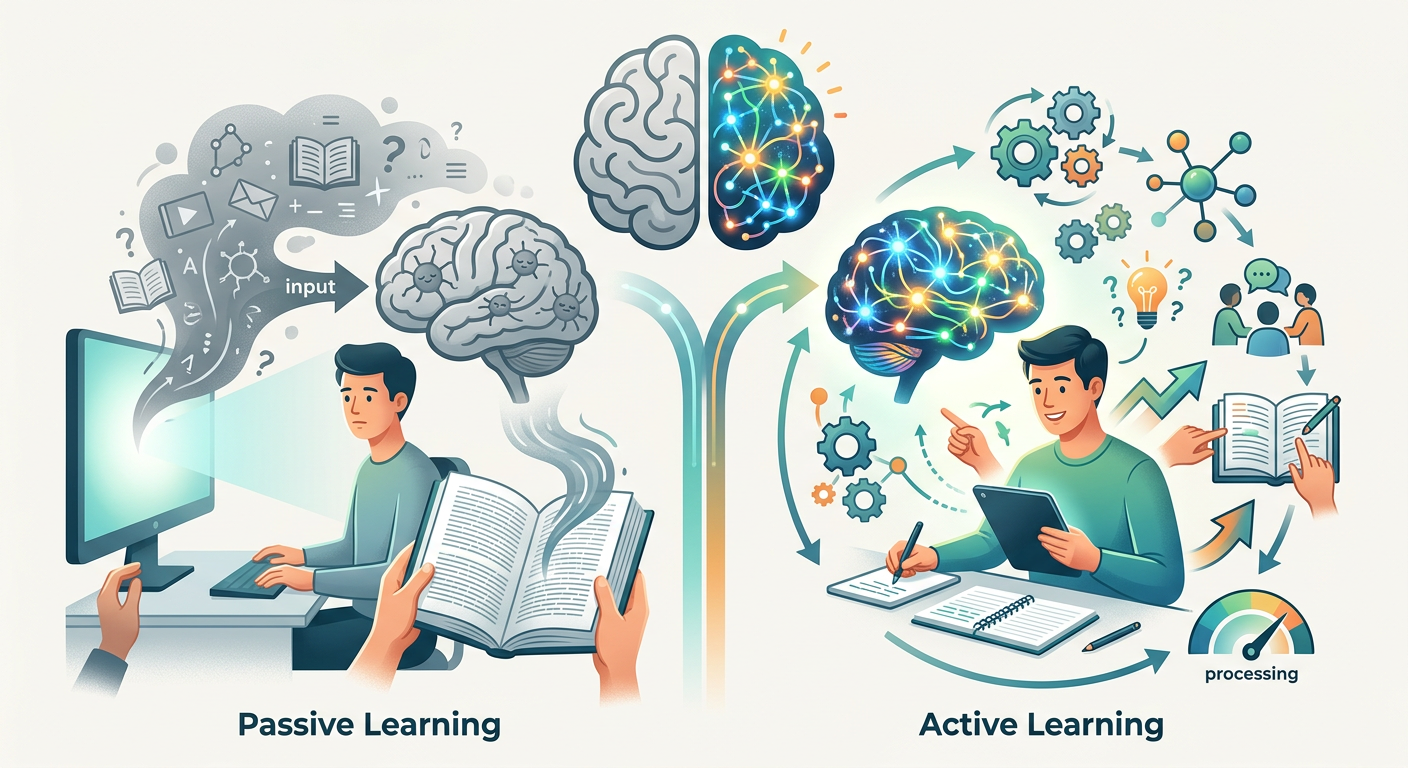
Active learning is more effective because it aligns with how our neurons form long-term memories through a process called long-term potentiation. When you engage in passive vs active learning, you are choosing between superficial recognition and deep structural change in the brain. Passive listening might activate your auditory cortex, but active problem-solving recruits the prefrontal cortex and hippocampus, the centers of higher-order thinking and memory.
Cognitive Load Theory suggests our working memory has a finite capacity. Passive learning often overwhelms this capacity with a "firehose" of information that we cannot process in real-time. Active strategies, such as active recall vs rereading, help manage this load by breaking information into "chunks" that the brain can more easily store and retrieve later.
A major pitfall of passive methods is the "Illusion of Competence." When you reread a textbook chapter, the material looks familiar, so your brain tricks you into thinking you know it. However, familiarity is not the same as retrieval. Without the "desirable difficulty" of active testing, you aren't actually building the neural pathways required to recall that information under the pressure of an exam.
Synaptic pruning and the "forgetting curve", a concept pioneered by Hermann Ebbinghaus, show that we lose nearly 70% of new information within 24 hours if we don't engage with it. Active engagement acts as a "save button." By forcing the brain to retrieve a memory, you signal to your biology that this specific information is valuable, preventing it from being pruned away during sleep.
Deep Dive into Passive Learning: Benefits and Pitfalls
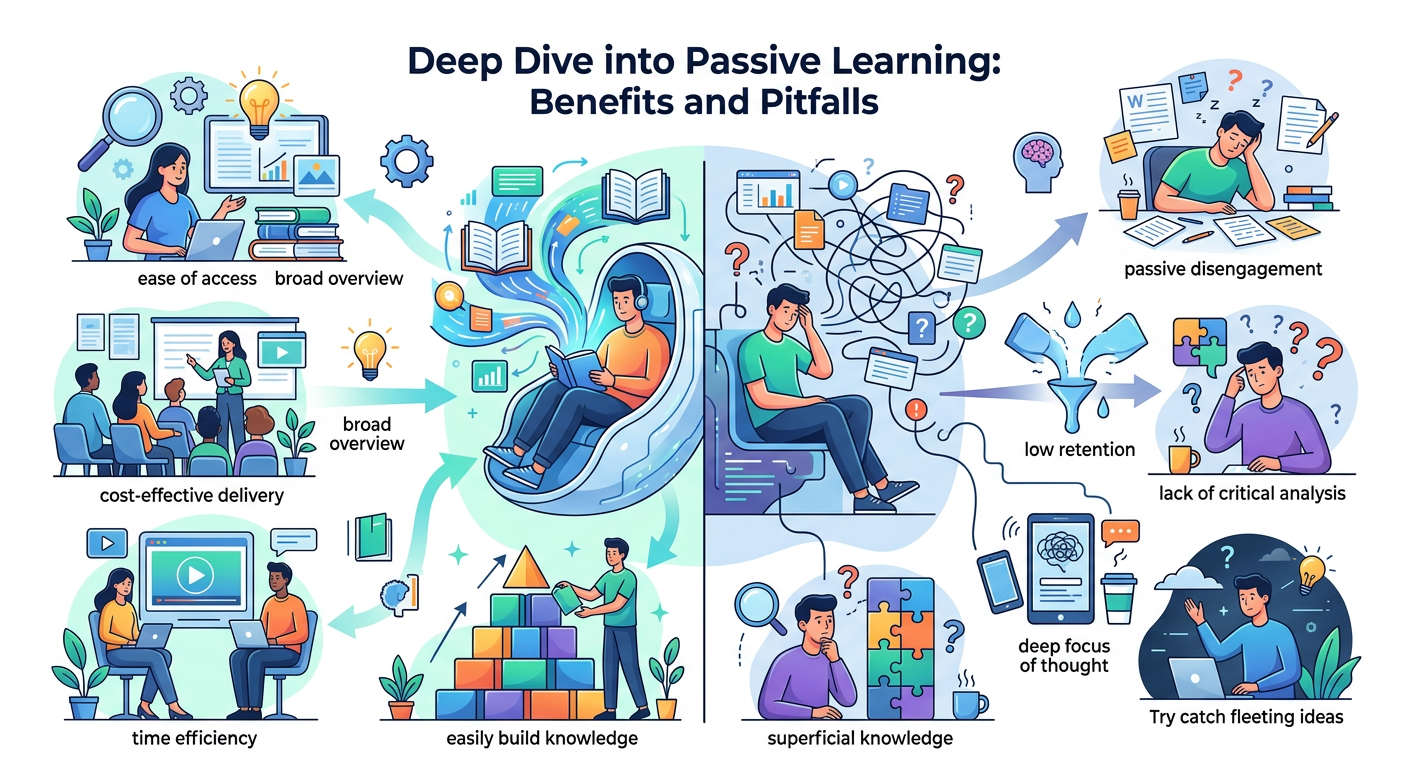
Passive learning acts as a necessary gateway for initial exposure to new, unfamiliar concepts. You cannot solve a complex physics equation if you haven't first sat through a lecture explaining what the variables represent. Its primary benefit is accessibility; anyone can put on a podcast or watch a YouTube video while commuting, making it a "low floor" entry point into any subject.
However, the pitfalls are significant. Passive learning results in superficial understanding that rarely survives the transition to real-world application. It is the academic equivalent of watching someone else go to the gym; you might understand the mechanics of a bench press, but your own muscles aren't growing. If you rely solely on these methods, you may find yourself searching for an active recall guide at the last minute when you realize you can't remember the details.
Examples of passive learning include:
-
Listening to a traditional university lecture without taking notes.
-
Watching documentaries or educational videos.
-
Reading a textbook or highlighting passages.
-
Listening to an audiobook while multitasking.
While these activities have a place in a master study schedule, they should never be the "meat" of your learning process. Use them for the first 20% of your time to gain context, then immediately pivot to more strenuous activities.
Deep Dive into Active Learning: Strategies and Outcomes
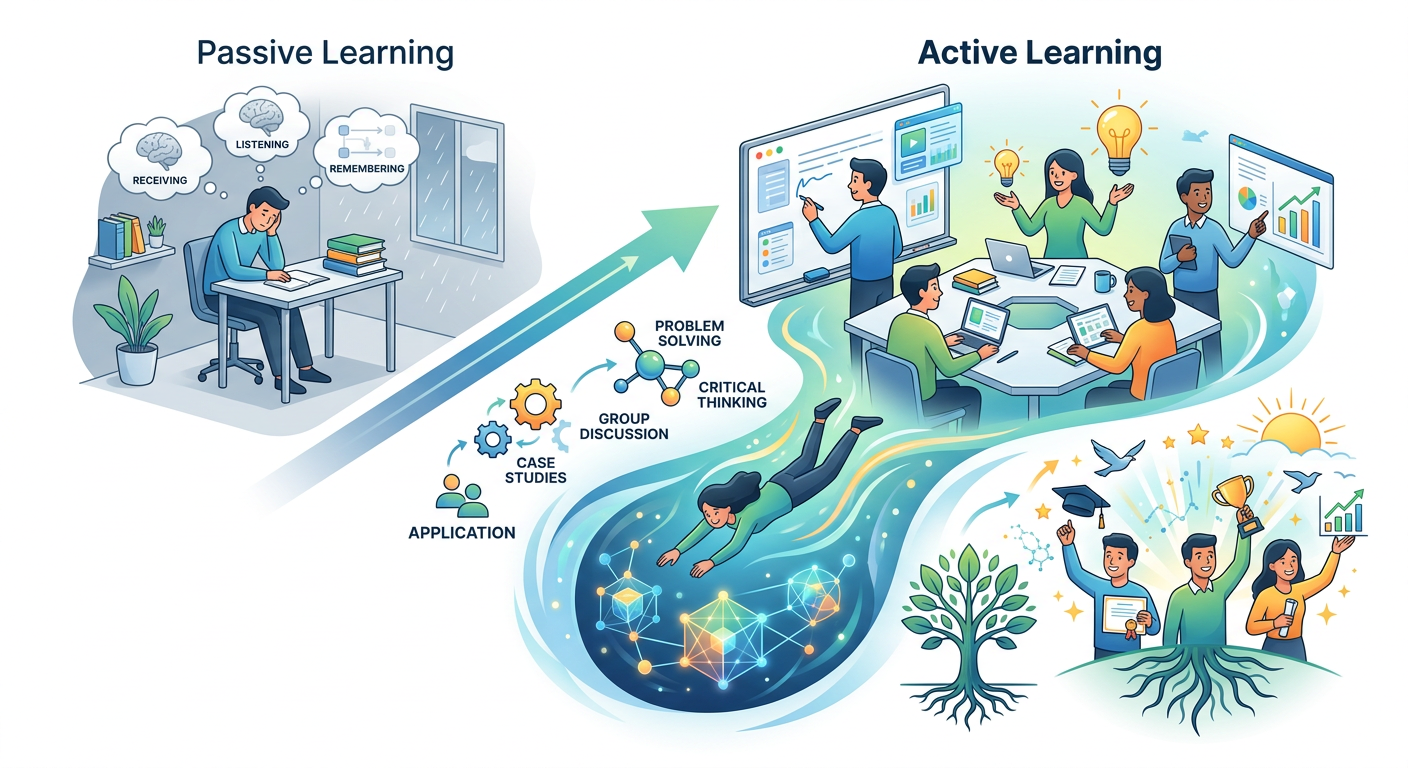
Active learning strategies prioritize the "output" of information as much as the "input." According to The American Psychological Association, practicing retrieval is one of the most robust ways to ensure long-term retention. These methods push you up the levels of Bloom's Taxonomy, moving you from simple "remembering" to "analyzing" and "creating."
One of the most powerful tools in this category is the Feynman Technique. This involves explaining a concept in simple terms as if you were teaching a child. If you stumble or use jargon you can't define, you've identified a "knowledge gap." This is a cornerstone of efficient study techniques because it turns learning into a feedback loop.
Other vital active strategies include:
-
Spaced Repetition: Reviewing material at increasing intervals to fight the forgetting curve.
-
Interleaving: Mixing different topics or problem types (like alternating between molarity questions and molality questions) to improve your ability to distinguish between concepts.
-
Self-Explanation: Explaining to yourself why a certain step in a process is necessary.
Active learning often feels frustrating or "slower" than reading. This frustration is actually a sign of "desirable difficulty." The mental strain you feel is the sound of neural pathways being forged. If the learning feels easy, you probably aren't doing it right. This is why many students fall into the trap of studying the wrong way—they confuse ease with effectiveness.
Ready to Stop Forgetting?
Transform your study sessions from passive scrolling to active mastery. Bevinzey uses science-backed algorithms to ensure you spend your time on what actually works.
Get Started FreeHead-to-Head Comparison: Retention, Efficiency, and Practicality
Retention rates are highest when students are forced to teach others or apply knowledge immediately. While the exact percentages of the famous "Learning Pyramid" are often debated, the core takeaway remains consistent: we remember roughly 10% of what we read, but 90% of what we teach or use immediately. In the battle of passive vs active learning, the latter wins every time for durability.
In terms of efficiency, passive learning actually takes more time in the long run. If you spend 10 hours reading a textbook but forget 90% of it, your "Return on Investment" (ROI) is abysmal. Spending 3 hours on science-backed study techniques like flashcards or practice tests results in much higher retention, saving you hours of frantic re-learning before an exam.
For simple information, like memorizing a list of vocabulary, passive exposure might suffice for the short term. However, for complex systems, like understanding the difference between molarity and molality, active engagement is non-negotiable. You cannot "absorb" the nuance of these chemical concentrations just by looking at the formulas; you must work through practice questions to see how they behave in different scenarios.
"The only way to learn a new way of thinking is to practice it." — Dr. Richard Feynman
How to Transition from a Passive to an Active Learner
Converting your habits requires a conscious move from being a spectator to being a participant. Start with your note-taking. Instead of transcribing exactly what a professor says (passive), use the Cornell Method or write down "Questions for my future self" (active). This forces you to process the information in real-time to determine what is actually important.
Integrate self-testing into every study session. Before you open your book, try to write down everything you remember about the topic from the previous day. This is a form of "pre-testing," which researchers have found prepares the brain to absorb the correct information more effectively once you finally begin reading. It is a key part of mastering your grades.
Embrace technology as a facilitator, not a distraction. Tools like AIflashcard.net or Anki for flashcards or Notion for structured "Second Brain" databases allow you to organize your active recall sessions. Instead of just storing information, focus on creating a structured study plan that forces you to revisit difficult topics on a schedule.
Finally, implement the "Teach What You Learn" mentality. You don't need a real classroom to do this. Explain a concept to your dog, your mirror, or write a blog post about it. Summarizing a complex topic into its most essential parts is the ultimate active learning exercise.
The Hybrid Approach: Finding the 'Sweet Spot' in Education
The most successful learners use a hybrid model, often referred to in academia as the "Flipped Classroom." In this model, the passive intake (watching videos or reading) happens at home, while the active application (problem-solving, debate, and experiments) happens during the core "study time." This ensures that you aren't wasting your peak cognitive energy on low-value tasks.
The 80/20 Rule of Learning is a great benchmark: spend 20% of your time on passive consumption and 80% on active production. If you are studying chemistry, spend 10 minutes reading about a formula and 40 minutes solving moles to grams practice questions. This ratio ensures that you have the necessary context without getting stuck in the "consumption trap."
Building a sustainable learning habit means recognizing that these two modes feed each other. Passive intake provides the "fuel," but active learning is the "engine" that moves you forward. By balancing both, you create a feedback loop where your active testing identifies gaps that your next passive session can fill.
Whether you are preparing for medical boards or learning a new language, the goal is always mastery. Moving beyond the debate of passive vs active learning and into a strategy that combines both will allow you to learn faster, remember longer, and understand deeper. Stop being a passenger in your own education and start driving the process.
Master Any Subject with Bevinzey
Stop wasting hours on passive rereading. Our platform turns your notes into active recall challenges instantly. Join thousands of students who have optimized their learning destiny.
Get Started FreeFrequently Asked Questions
Which is better: passive or active learning?
Active learning is significantly better for long-term retention and deep understanding. Passive learning is useful for the initial introduction to a topic, but it should only make up a small fraction of your total study time.
Can you combine passive and active learning methods?
Yes, and you should. Use passive methods (reading, listening) to gain a foundational overview, then immediately pivot to active methods (practice testing, teaching) to solidify that knowledge and identify gaps.
Is reading a book considered passive or active learning?
Usually, reading is passive because you are simply receiving information. However, you can make it active by taking notes in your own words, pausing to predict the next section, or summarizing what you read after every five pages.
Why is active learning more effective for long-term memory?
Active learning triggers long-term potentiation, which strengthens the synapses between neurons. It forces the brain to retrieve information, which signals that the data is important, making it more likely to be stored in long-term memory.
What are some examples of active learning activities for adults?
Common examples include the Feynman Technique, using spaced repetition software, participating in group debates, solving case studies, or completing technical practice problems.
How does the 'Learning Pyramid' relate to these two styles?
The Learning Pyramid suggests that passive methods like lectures and reading have the lowest retention rates (5-10%), while active methods like "practice by doing" and "teaching others" have the highest (75-90%).
Enjoyed this article?
Share it with others who might find it helpful.
Related Articles
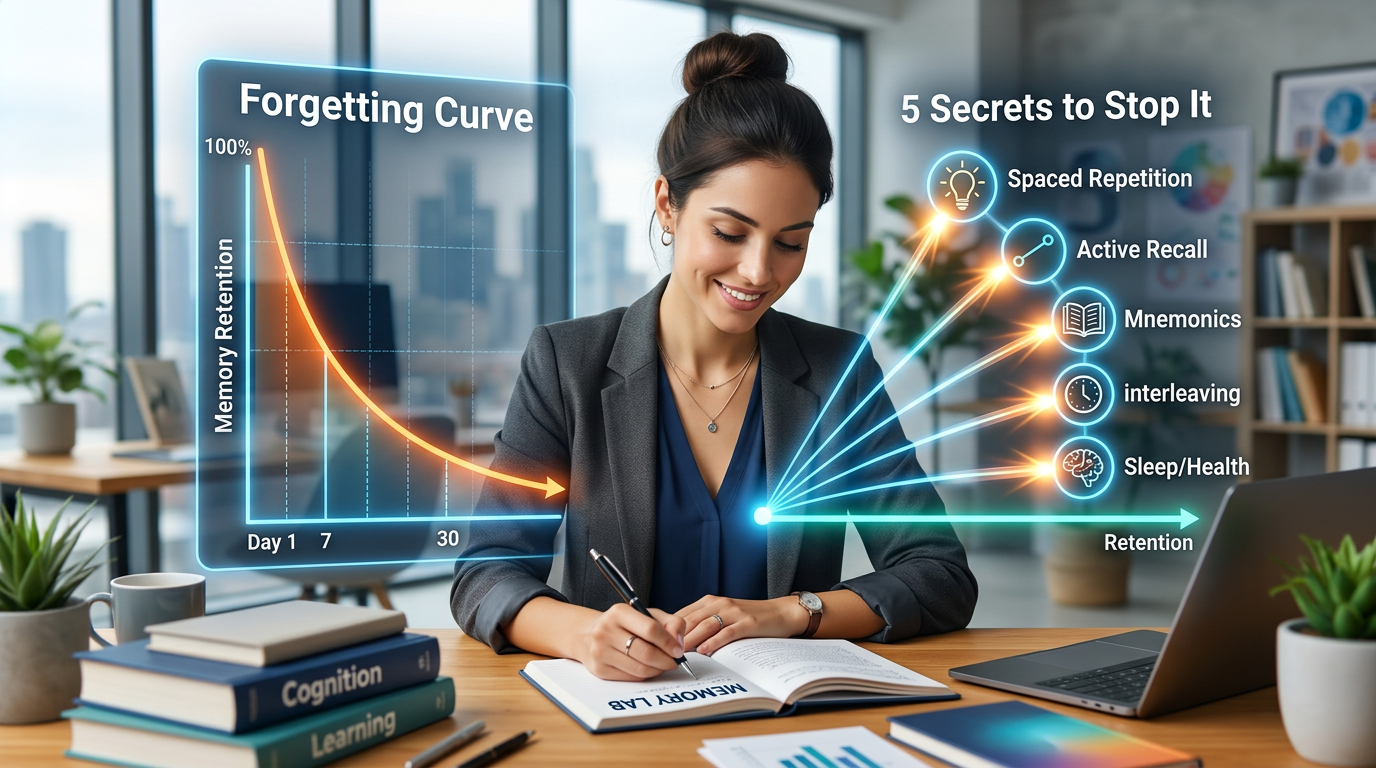
The Forgetting Curve: Why We Forget and 5 Secrets to Stop It
Master your memory with our deep dive into the forgetting curve. Learn how Hermann Ebbinghaus's theory works and discover 5 proven strategies to stop forgetting.
Mar 29, 2026

8 Best Study Apps to Boost Your Grades in 2026
Discover the top study apps that can revolutionize your learning and help you achieve academic success. Compare features, pricing, and find the perfect app for your needs.
Mar 28, 2026

Unlock Your Potential: Why Studying Feels Ineffective (And How to Fix It)
Feeling like your study efforts are getting nowhere? Discover the hidden reasons why studying feels ineffective and learn actionable strategies to boost your learning and retention.
Mar 28, 2026