Master Your Memory: The Ultimate Guide to Active Recall for Effective Study

Many students spend hours poring over textbooks, highlighting every other sentence, and rereading their notes until their eyes glaze over. They feel productive, yet come exam time, much of that information vanishes like smoke. Sound familiar? That's because these common study habits are largely ineffective. The real key to encoding information firmly in your long-term memory lies in a potent strategy known as active recall.
Active recall isn't just another buzzword in the crowded field of effective study techniques. It's a scientifically validated approach that transforms how you interact with information, pushing your brain to work harder and, consequently, learn better. Unlike passive methods, active recall forces your mind to retrieve facts, concepts, and procedures from scratch, strengthening the neural pathways associated with that knowledge.
What is Active Recall and Why Does it Work?
Active recall involves retrieving information directly from your memory, rather than simply re-exposing yourself to it. This process, often called retrieval practice, makes for stronger, more durable memories.
Defining Active Recall: Beyond Rereading
Think of it this way: when you reread a chapter, your brain recognizes the information. "Oh, I've seen that before," it says. That recognition often masquerades as true understanding, but it’s a superficial connection.
Active recall, however, demands more. It asks you to pull that information out of the depths of your mind without external cues, much like recalling a friend's phone number from memory instead of looking it up in your contacts. This effortful retrieval is what builds lasting knowledge.
The Science Behind It: How Your Brain Retains Information
The effectiveness of active recall stems from several cognitive mechanisms, most notably the retrieval practice effect and the testing effect.
When you successfully retrieve information, your brain signals that this piece of knowledge is important and should be retained. Each retrieval strengthens the memory trace, making it easier to access next time. Studies have shown that repeatedly testing oneself dramatically improves long-term memory compared to repeated studying. For instance, a 2008 study published in Science demonstrated that students who were tested frequently retained 50% more information a week later than those who only restudied.
Passive vs. Active Learning: The Critical Difference
The distinction between passive and active learning is foundational to understanding why certain study methods fail while others succeed. Many traditional study habits fall squarely into the passive camp.
Rereading notes, highlighting text, or simply listening to a lecture without engaging mentally are all forms of passive learning. Your brain acts more like a recipient, soaking up information without deeply processing it. This feels comfortable because it requires little cognitive effort.
Active learning, by contrast, demands engagement. It's about questioning, analyzing, problem-solving, and, crucially, retrieving. This deliberate effort not only solidifies existing knowledge but also helps you identify gaps in your understanding a crucial aspect of academic growth. Consider why students struggle with molarity; often, it's not the math, but a fundamental misunderstanding of the concept itself, which active recall can pinpoint.
Benefits of Active Recall: Why It's Superior
The advantages of integrating active recall into your study routine are manifold.
First and foremost, it leads to superior long-term retention. Information acquired through active retrieval sticks around far longer than information learned passively. Furthermore, active recall fosters deeper understanding, as you're not just memorizing facts, but recalling them within a broader context, leading to better comprehension. It also gives you a proven step-by-step guide to studying effectively. Perhaps its greatest strength, beyond retention, is its ability to precisely identify knowledge gaps.
When you can't recall a piece of information, that's a clear signal you need to revisit it. This targeted approach makes your studying much more efficient. Instead of mindlessly reviewing everything, you focus your efforts where they're most needed. Many students continue to make common study mistakes often due to not leveraging active recall effectively.
Transform Your Study Habits with Bevinzey

Ready to stop passive learning and start truly mastering material? Our platform integrates powerful active recall tools to help you study smarter, not just harder.
Get Started FreeCore Techniques for Implementing Active Recall
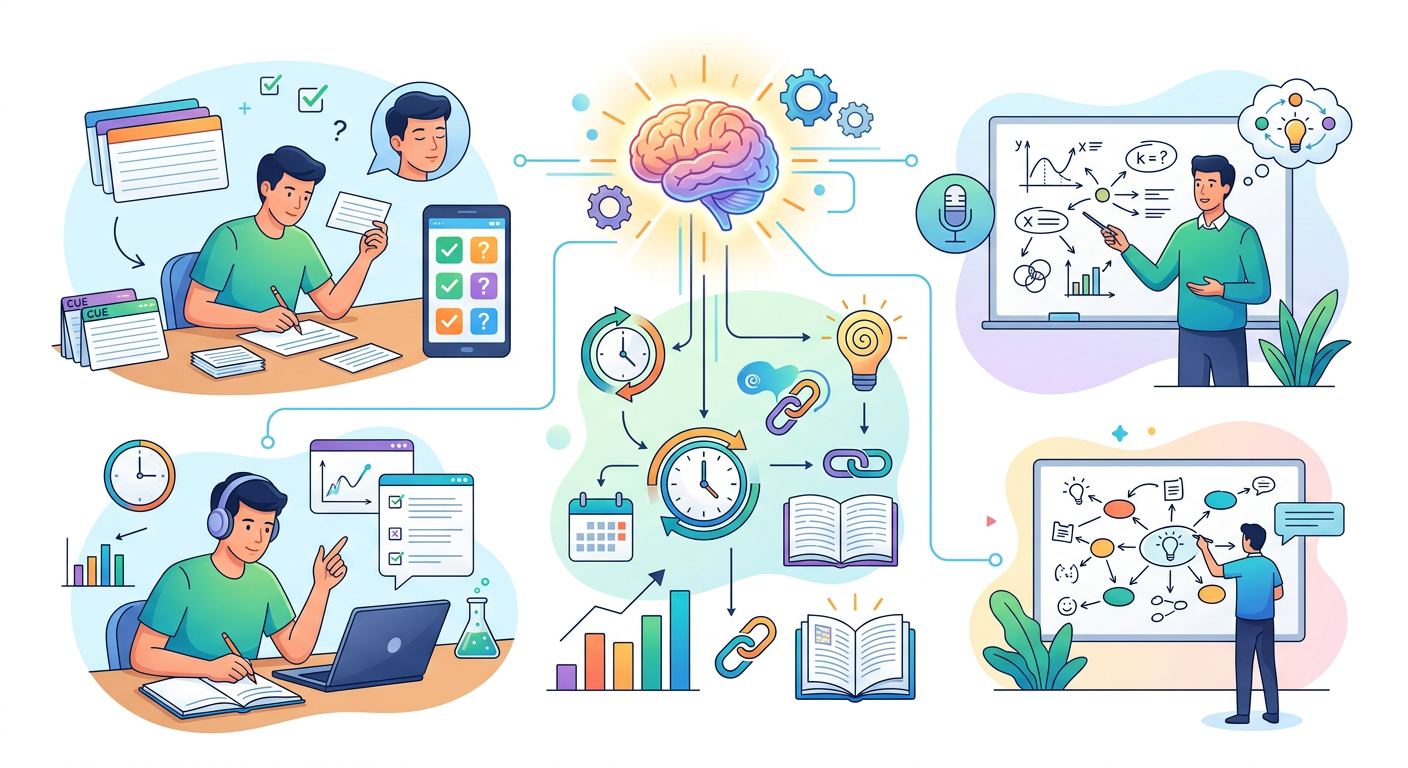
You can integrate active recall into your study routine using several practical methods. These techniques move beyond mere recognition to demand genuine retrieval of information.
Flashcards: The Classic Method Reimagined
Flashcards remain a cornerstone of active recall, but their effectiveness depends on proper use.
Traditional paper flashcards work well. Write a question or concept on one side and the answer or definition on the other. Digital tools like Anki, AIflashcard.net or Quizlet offer even greater power, especially when combined with spaced repetition algorithms. These platforms show you more difficult cards more often, optimizing your review schedule.
When creating flashcards, focus on quality over quantity. Avoid overloading a single card with too much information. Craft questions that require critical thinking, not just simple factual recall. For instance, instead of "What is the capital of France?" try "Describe three key cultural aspects of Paris."
Practice Questions and Self-Quizzing: Testing Your Knowledge
Regularly testing yourself is one of the most effective ways to employ active recall.
You can create your own questions based on your notes or textbook chapters. Many textbooks also come with end-of-chapter questions, which are excellent for self-quizzing. Even better, find or create practice questions that mimic actual exam formats. This not only tests your recall but also familiarizes you with the pressure of a timed assessment.
The goal isn't just to get the right answer, but to identify what you don't know. If you struggle with a question, don't just peek at the answer. Go back and review the relevant material, then try the question again later. This iterative process strengthens your understanding much more than simply reading the solution.
Summarization and Explaining: Teaching to Learn
Explaining a concept in your own words, often called the "Feynman Technique," is a powerful act of active recall and elaboration.
After studying a topic, try to summarize it without referring to your notes. Pretend you're explaining it to a child or someone completely unfamiliar with the subject. This forces you to simplify complex ideas and identify any areas where your understanding is fuzzy.
Talking through a concept aloud, teaching it to a study partner, or even just writing a concise summary paragraph all serve the same purpose: they make your brain retrieve and synthesize information actively. You'll find 8 science-backed secrets to mastery often involve this kind of deep processing.
Blurting and Free Recall: Unleashing Your Memory
Blurting is a raw, unimpeded form of active recall that can be surprisingly effective.
After a study session or reading a chapter, close your book and notes. Take a blank piece of paper and write down everything you can remember about the topic. Don't worry about order or neatness. Just "blurt out" all the facts, definitions, examples, and connections that come to mind. This is similar to what Harvard's Derek Bok Center for Teaching and Learning often recommends for engaging with complex material.
Once you've exhausted your memory, compare your blurted notes with your original study material. Highlight any gaps or inaccuracies. This immediate feedback loop is crucial for reinforcing what you know and pinpointing what needs further attention. Regular practice of blurting significantly improves memory retention.
Concept Mapping and Diagramming: Visualizing Connections
Concept maps and diagrams transform abstract information into visual, interconnected structures, aiding active recall.
Start with a central topic, then branch out with key sub-topics, details, and examples. The act of creating the map itself is an exercise in active recall, as you must retrieve and organize information. Furthermore, these visual aids provide excellent cues for future retrieval practice.
Creating flowcharts for processes, diagrams for anatomical structures, or mind maps for literary themes all engage different parts of your brain. Instead of passively looking at a pre-made diagram, constructing one yourself forces a deeper interaction with the material. This method works particularly well for subjects like chemistry, where understanding relationships between concepts (e.g., molarity formula explanations or solving hard molarity practice questions) is crucial.
Integrating Active Recall with Other Powerful Study Strategies
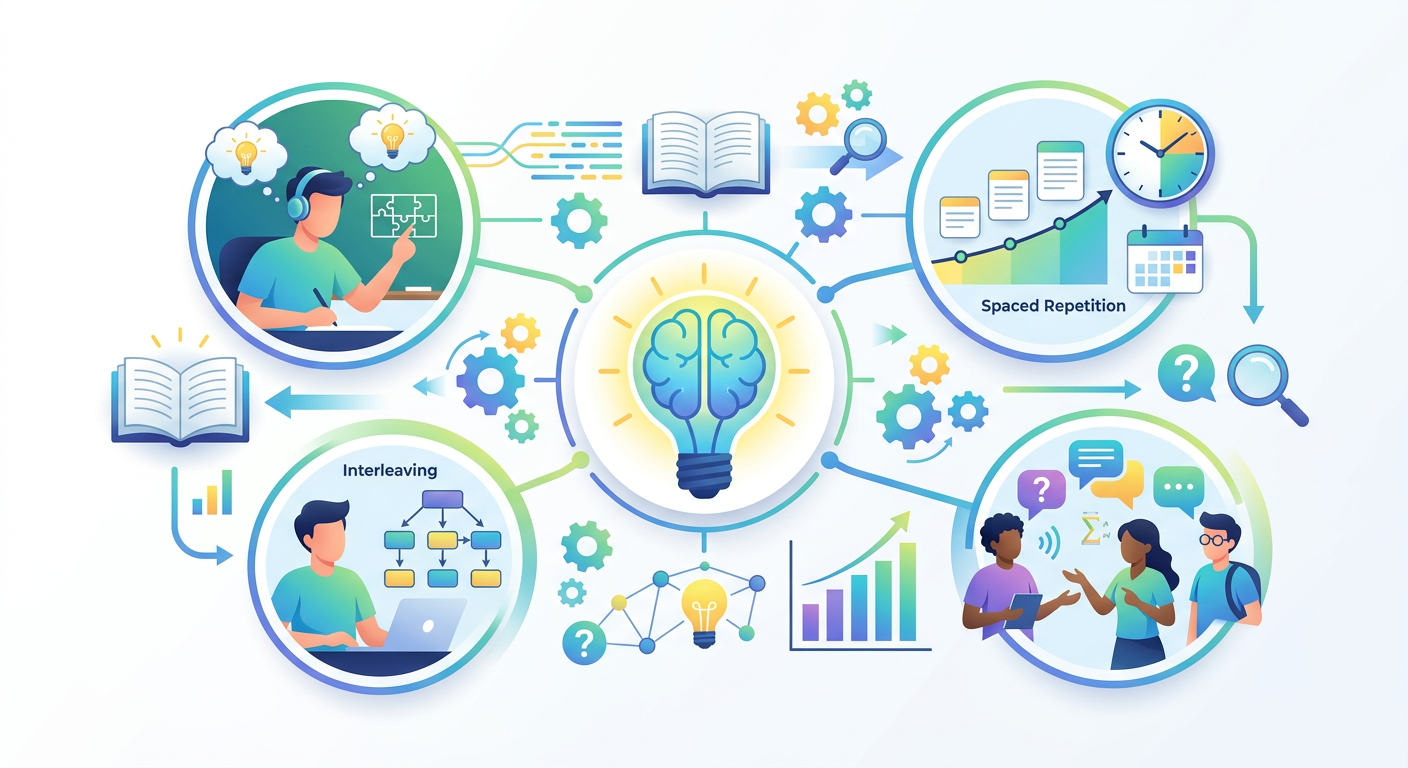
Active recall gains even more power when combined with other evidence-based study techniques. These strategies complement each other, creating a robust and efficient learning system.
Spaced Repetition: The Perfect Partner for Active Recall
Spaced repetition involves reviewing material at increasing intervals, right before you start to forget it.
Combining active recall with spaced repetition is considered by many learning scientists to be the most effective study method known. Tools like Anki automate this process by tracking your performance on flashcards and scheduling them for review at optimal times. Instead of cramming, you distribute your learning over time. This makes your study sessions more efficient, leading to superior long-term retention with less effort than traditional methods.
Imagine you're learning new vocabulary. You recall a word today. If you get it right, the system shows it to you again in a few days. Get it wrong, and you see it again much sooner. This intelligent scheduling ensures you're always challenging your memory at just the right moment, reinforcing the learning without wasting time on what you already know perfectly. This combination is key to study techniques that actually work.
Interleaving: Mixing Subjects for Better Retention
Interleaving involves mixing different but related subjects or topics within a single study session.
Instead of dedicating an hour solely to organic chemistry, then an hour to physics, try mixing them. Perhaps you do 20 minutes of organic chemistry practice questions, then 20 minutes of physics problems, then switch back. This practice prevents your brain from falling into a rut and forces it to recall different information sets.
Interleaving makes learning more challenging initially, but it significantly improves your ability to differentiate between concepts and apply the correct approach to diverse problems. This is especially helpful for subjects where concepts are often confused, like in chemistry (Molarity vs. Molality, for example).
Elaboration: Connecting New Information to Existing Knowledge
Elaboration means asking "why" and "how" questions, connecting new information to what you already know, or relating it to personal experiences.
When you encounter a new concept, don't just passively absorb it. Actively think about how it relates to other things you've learned. How does it fit into the bigger picture? Can you think of an example from your daily life that illustrates this concept? For a chemistry student, for example, understanding what molarity is becomes much clearer when you relate it to making a specific concentration of a sports drink.
This process builds a richer, more interconnected web of knowledge in your brain, making information easier to recall because there are more pathways leading to it. The more connections you make, the stronger the memory.
Metacognition: Knowing How You Learn Best
Metacognition refers to thinking about your own thinking, monitoring your understanding, and adjusting your study methods accordingly.
When you engage in active recall, you're not just retrieving information; you're also assessing your performance. Did you answer correctly? Was it easy or difficult? This self-assessment is a core component of metacognition. It allows you to identify your strengths and weaknesses accurately, guiding your future study choices.
Effective learners are metacognitively aware. They know when they genuinely understand something versus when they're merely familiar with it. They adapt their strategies, spending more time on challenging areas and less on mastered ones. This mindful approach to learning is essential for optimizing your study time and efforts.
Practical Tips for Mastering Active Recall in Any Subject
Adopting active recall effectively requires more than just knowing what it is; it demands practical application and refinement. Here's how to integrate it seamlessly into your routine.
Starting Small: Incorporating Active Recall Gradually
Don't try to overhaul all your study habits overnight; begin with manageable steps.
Start with simple active recall questions after reading a short section of a textbook. For example, after reading a paragraph, close the book and try to summarize its main point in one sentence. Gradually increase the complexity of your self-questions and the amount of material you try to recall. This incremental approach builds confidence and prevents burnout.
Even dedicating just 10-15 minutes of an hour-long study session to active recall can make a significant difference. Over time, you'll naturally find yourself gravitating towards these more effective strategies. This is a key part of how to study effectively for exams, focusing your efforts where they count most.
Creating Effective Recall Cues and Questions
The quality of your recall cues directly impacts the depth of your active learning.
Instead of writing vague questions like "What about Chapter 3?", craft specific, open-ended questions that require more than a yes/no answer. Use "How," "Why," and "Explain" prompts. For instance, if studying chemistry, instead of "What is a mole?", ask "Explain the significance of Avogadro's Number in chemical calculations." (Avogadro's Number practice questions would help here).
Think about the kinds of questions your professor asks on exams. Design your personal recall questions to mirror that level of critical thinking and synthesis. This technique makes your active recall practice highly relevant to your assessment.
Dealing with Incorrect Answers: Learning from Mistakes
Getting an answer wrong during active recall isn't a failure; it's a powerful learning opportunity.
When you can't recall something or get an answer wrong, immediately identify where the error occurred. Go back to your notes or textbook, review the concept, and understand what led to your mistake. Crucially, don't just reread the correct answer. Re-engage with the material and then re-test yourself on that specific point later.
This process of identifying, reviewing, and re-testing strengthens the memory pathways around that specific piece of information. Embrace mistakes as signposts guiding you toward areas that need more attention. This iterative feedback loop is fundamental to deep learning.
Staying Motivated: Making Active Recall a Habit
Consistency is key to forming any new habit, especially something that feels more cognitively demanding like active recall.
Set realistic goals, such as "I will spend 20 minutes doing active recall flashcards every day." Track your progress to see how far you've come. Reward yourself for sticking to your routine, perhaps with a short break or a favorite activity. Over time, the tangible benefits of better recall and understanding will become their own reward.
Find study buddies who are also committed to active recall. Quizzing each other can make the process more engaging and hold you accountable. Making it a regular, non-negotiable part of your study routine transforms it from a task into a natural component of your learning process.
Tools and Resources to Support Your Active Recall Journey
Several tools can streamline and enhance your active recall practice. Digital flashcard apps like Anki, Quizlet, and Cerego leverage spaced repetition algorithms, making them exceptionally efficient.
For more analog approaches, dedicated recall journals or notebooks can be useful for blurting and self-testing. Online platforms often provide practice questions with answers for various subjects, which can be invaluable resources. Also, browser extensions that allow you to highlight and create flashcards directly from web pages can integrate active recall into your digital reading habits. A smart blend of digital and physical tools can significantly empower your active recall journey.
Common Challenges and How to Overcome Them
While incredibly effective, active recall can present some initial hurdles. Understanding these challenges and how to address them will help you stick with the strategy.
Feeling Overwhelmed: Breaking Down Complex Topics
Facing a massive amount of information can make active recall seem daunting.
The solution lies in "chunking" the material. Don't try to recall an entire chapter at once. Break it down into smaller, manageable sections or sub-topics. Focus on recalling the key ideas of one section before moving to the next. For example, if you're studying a complex chemical process, first focus on understanding and recalling the reactants, then the conditions, then the products, and so on. This approach makes the task less intimidating and builds confidence incrementally, a vital strategy for why most students study wrong.
Moreover, start with the big picture concepts. Once you can recall the main ideas, then drill down into the supporting details. This hierarchical approach reduces cognitive load.
Time Constraints: Maximizing Efficiency
Many students feel they don't have "extra" time for active recall, especially when deadlines loom.
Efficiently integrate active recall into your existing routine. Instead of just rereading your notes on the bus, try to recall key points. During lectures, pause frequently in your notes to summarize the last few points in your own words. When reading a textbook, after every paragraph or subheading, close the book and try to recall its essence. Even short, frequent bursts of active recall throughout the day are more effective than long, infrequent passive study sessions.
Remember, active recall isn't about adding more time; it's about making the time you already spend studying more productive. The initial investment in effort pays off in reduced overall study time later because you retain information better.
Lack of Feedback: Self-Assessment Strategies
Without a teacher providing immediate feedback, it's easy to wonder if your recall is truly accurate.
Develop robust self-assessment strategies. When using blurting, compare your recalled information directly with your original notes, textbook, or a reliable summary. Highlight gaps and errors in a different color. For flashcards, be brutally honest with yourself about whether you truly knew the answer before revealing it. If using digital tools like Anki, their algorithms provide objective feedback.
Peer feedback can also be invaluable. Study with a friend and quiz each other. Discussing concepts and comparing explanations can illuminate areas of misunderstanding for both of you. This process of critical self-evaluation and cross-referencing ensures you're on the right track.
Initial Frustration: Trusting the Process
Active recall can feel harder and slower than passive study methods, leading to frustration, especially when you struggle to recall information.
Understand that this "desirable difficulty" is precisely why active recall works. The struggle to retrieve information is what strengthens the memory. If it feels hard, it means your brain is working, and that's a good thing. Resist the urge to quickly peek at the answer. Give your brain a moment to genuinely try and retrieve it.
Trust the science. Numerous studies in cognitive psychology support the efficacy of active recall. Keep pushing through the initial discomfort, and you will see significant improvements in your memory and understanding. The benefits far outweigh the temporary feeling of struggle.
Active Recall for Different Learning Scenarios
Active recall is remarkably versatile; you can adapt it to almost any learning situation or subject matter.
Exams and Tests: Applying Active Recall Under Pressure
When preparing for exams, active recall moves beyond simple review to strategic application.
Create mock tests for yourself using past exam papers, textbook problems, or your own self-generated questions. Practice answering questions under timed conditions to simulate the actual exam environment. The "recall sheet" method is also highly effective: on a blank sheet of paper, write down everything you can remember about a specific topic expected on the exam. Then, compare it to your notes and fill in the gaps. This technique not only identifies weak areas but also builds confidence in your comprehensive knowledge, a critical component for hard solution preparation practice questions or other challenging topics.
This focused practice helps to cement information and improve your ability to retrieve it under high-pressure situations, directly combating test anxiety.
Reading Textbooks and Articles: Transforming Passive Consumption
Turn your reading sessions from passive absorption into active recall opportunities.
Before you start a new chapter or section, skim the headings and subheadings and try to predict what information will be covered. As you read, pause frequently—ideally after every paragraph or two—and actively ask yourself: "What was the main point of what I just read?" Then, try to state it in your own words without looking back at the text. You can also create small flashcards for key terms or concepts encountered during reading.
This method, sometimes called "SQ3R" (Survey, Question, Read, Recite, Review), forces you to actively engage with the material rather than letting your eyes merely glide over the words. It ensures that actual learning, not just exposure, occurs during your reading time.
Lectures and Presentations: Maximizing Real-Time Learning
Lectures can often feel passive, but active recall can transform them into powerful learning experiences.
During a lecture, rather than just diligently taking notes, try to mentally (or even physically, by writing in the margins) summarize key points every 5-10 minutes. At designated breaks or immediately after the lecture, close your notebook and try to recall the main themes, important definitions, and any questions you had. You can quickly jot these down in a "recall section" of your notes.
If the lecturer asks a question, actively try to form an answer in your head before they provide it. Engaging with the material as it's presented helps encode it more effectively, reducing the amount of review needed later.
Skill-Based Learning: Integrating Active Recall into Practice
Active recall isn't just for rote memorization; it's invaluable for skill-based subjects like math, coding, or playing a musical instrument.
When solving a math problem, instead of just following the steps, pause at each critical juncture and try to recall *why* you're performing that specific operation or using a particular formula. Before looking at the solution, force yourself to work through the entire problem from memory. For programming, try writing small code snippets from scratch to recall syntax and logic, rather than always copy-pasting. In music, practice recalling melodic phrases or chord progressions without looking at the sheet music.
This method pushes you to retrieve procedures and rules, not just facts, making your practice much more deliberate and effective for true mastery. Even for hard ppm and ppb practice questions, recalling the underlying principles is key.
Stop Forgetting, Start Mastering
Ready to build a memory that lasts? Bevinzey's platform leverages the power of active recall and spaced repetition to make your studying stick. Get ready for exam success and deeper learning.
Get Started FreeFrequently Asked Questions
What is the difference between active recall and passive learning?
Active recall forces your brain to retrieve information from memory without cues, strengthening neural pathways and leading to better long-term retention. Passive learning, like rereading, involves re-exposure to information, which often leads to a false sense of familiarity without deep understanding.
How can I use active recall effectively with flashcards?
Create flashcards with specific, open-ended questions on one side and concise answers on the other. Use digital tools like Anki with spaced repetition to schedule reviews. Be honest about your recall, and revisit missed cards sooner.
Does active recall work for all subjects?
Yes, active recall is highly effective for nearly all subjects. While often associated with memorizing facts, it also strengthens understanding in subjects like math and science by forcing recall of formulas, processes, and problem-solving steps. You can even use it for chemistry problems like medium percent concentration practice questions.
How long should I spend on active recall each day?
Even 10-15 minutes of dedicated active recall practice per day can make a significant difference. Integrate it into your existing study sessions by adding short self-quizzing breaks after reading or listening to lectures. Consistency over duration is key.
Can active recall help with test anxiety?
Absolutely. By regularly practicing active recall, you build confidence in your ability to retrieve information under pressure. This reduces the uncertainty and fear often associated with test-taking, as you've effectively simulated the testing environment many times over.
What are some common mistakes to avoid when using active recall?
Avoid quickly peeking at answers, only using easy questions, trying to recall too much at once, and neglecting to review information you got wrong. Embrace the struggle of retrieval, break down complex topics, and learn from your mistakes for optimal results.
Enjoyed this article?
Share it with others who might find it helpful.
Related Articles

How to Study for Exams with Poor Memory
How to Study for Exams with Poor Memory
Apr 2, 2026

How to Study for Exams While Working Full-Time
This guide provides actionable strategies and proven techniques to help you navigate the complexities of studying for exams while working full-time, ensuring academic success without sacrificing your career or personal life.
Apr 2, 2026

How to Study for Exams as a Working Student
Learn how to effectively study for exams as a working student with strategic time management, efficient techniques, and well-being tips.
Apr 2, 2026