Work, Energy, Power Practice Questions with Answers
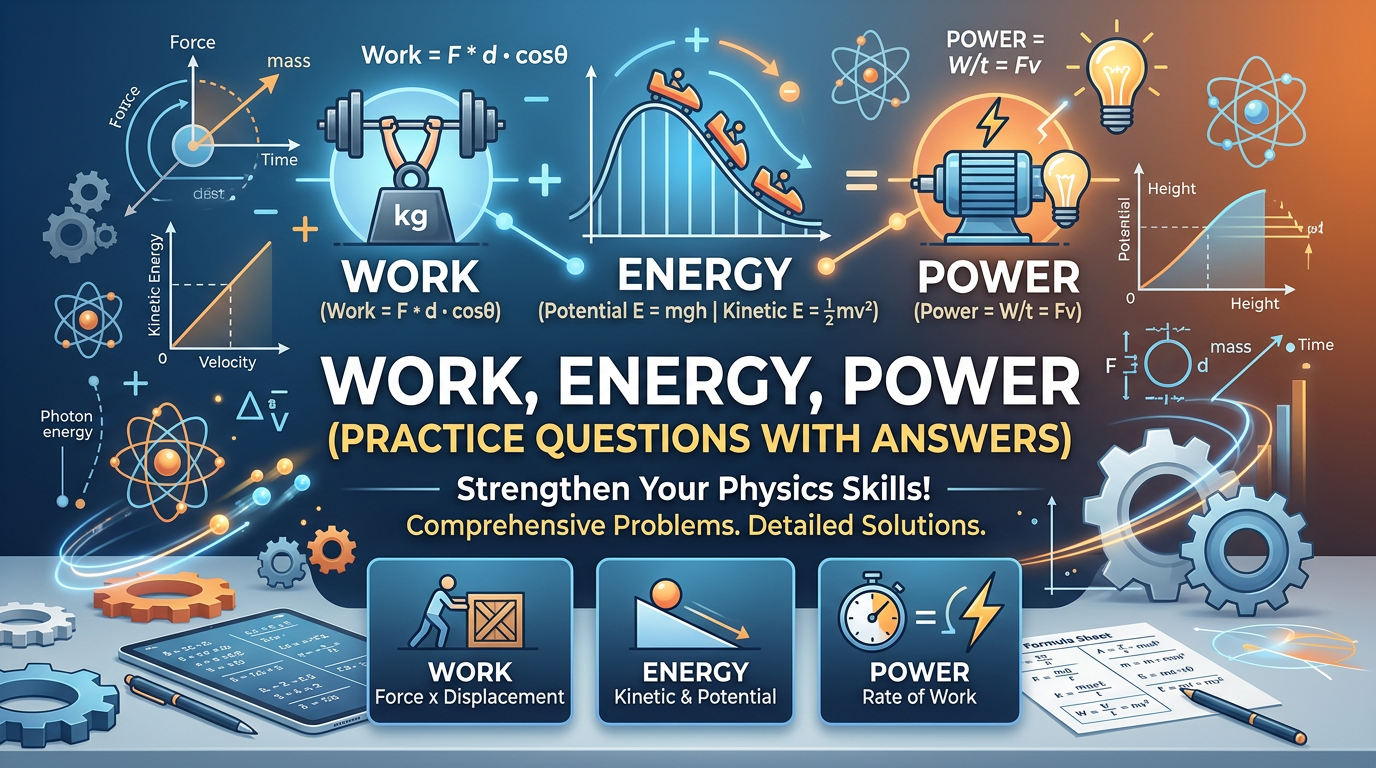
Work, Energy, Power Practice Questions with Answers
Understanding the relationship between work, energy, and power is fundamental to classical physics. These concepts describe how forces can cause motion and how quickly that process occurs. By mastering the principles of work, energy, and power, you can analyze everything from a simple thrown ball to the complex mechanics of a roller coaster. This guide provides clear explanations, worked examples, and a range of practice problems to solidify your knowledge.
Concept Explanation
Work, energy, and power are interconnected physical quantities where work is the transfer of energy, energy is the capacity to do work, and power is the rate at which work is done. These concepts are governed by specific formulas and principles, such as the Work-Energy Theorem and the Law of Conservation of Energy, which form the bedrock of mechanics.
What is Work?
In physics, work is done on an object when an applied force causes it to move a certain distance. For work to occur, the force must have a component in the direction of the displacement. The formula for work done by a constant force is:
W = F * d * cos(θ)
- W is the work done, measured in Joules (J).
- F is the magnitude of the applied force, measured in Newtons (N).
- d is the magnitude of the displacement, measured in meters (m).
- θ (theta) is the angle between the force vector and the displacement vector.
If the force is in the same direction as the displacement, θ = 0°, and cos(0°) = 1, so the formula simplifies to W = F * d. If the force is perpendicular to the displacement, θ = 90°, and cos(90°) = 0, so no work is done.
What is Energy?
Energy is defined as the capacity to do work. It exists in various forms, but in mechanics, we primarily focus on kinetic and potential energy.
- Kinetic Energy (KE) is the energy an object possesses due to its motion. The faster an object moves or the more massive it is, the more kinetic energy it has. The formula is:
KE = 1/2 * m * v², wheremis mass (kg) andvis velocity (m/s). - Potential Energy (PE) is stored energy based on an object's position or configuration. Gravitational potential energy is the most common form in introductory physics, related to an object's height above a reference point. The formula is:
PE = m * g * h, wheremis mass (kg),gis the acceleration due to gravity (approximately 9.8 m/s²), andhis the height (m).
The Work-Energy Theorem provides a crucial link between these concepts. It states that the net work done on an object is equal to the change in its kinetic energy: W_net = ΔKE. You can learn more about this theorem from Khan Academy's detailed explanation.
What is Power?
Power is the measure of how quickly work is done or how fast energy is transferred. An engine that does the same amount of work in half the time is twice as powerful. The formula for average power is:
P = W / t or P = ΔE / t
- P is power, measured in Watts (W), where 1 Watt = 1 Joule/second.
- W is the work done (J).
- ΔE is the change in energy (J).
- t is the time taken (s).
Understanding power is similar to understanding the calculations in Work Rate Problems, as both deal with a quantity per unit of time.
Solved Examples on Work, Energy, and Power
These solved examples demonstrate how to apply the formulas for work, energy, and power in different scenarios. Each step is broken down for clarity.
Example 1: Calculating Work Done at an Angle
Problem: A person pulls a 50 kg crate 15 meters across a horizontal floor with a rope that makes a 30° angle with the horizontal. The tension in the rope is 120 N. How much work is done by the person on the crate?
- Identify the knowns:
- Force (F) = 120 N
- Displacement (d) = 15 m
- Angle (θ) = 30°
- Choose the correct formula: The formula for work is
W = F * d * cos(θ). - Substitute the values and solve:
- W = 120 N * 15 m * cos(30°)
- cos(30°) ≈ 0.866
- W = 120 * 15 * 0.866
- W ≈ 1558.8 J
Answer: The work done by the person on the crate is approximately 1558.8 Joules.
Example 2: Conservation of Energy
Problem: A 2 kg ball is dropped from a height of 10 meters. Ignoring air resistance, what is its speed just before it hits the ground?
- Apply the principle of conservation of energy: The total mechanical energy at the top equals the total mechanical energy at the bottom.
PE_initial + KE_initial = PE_final + KE_final. - Define initial and final states:
- Initial (at the top): The ball is dropped, so initial velocity (v_i) = 0, meaning KE_initial = 0. The height (h_i) = 10 m.
- Final (at the bottom): The height (h_f) = 0, meaning PE_final = 0. We need to find the final velocity (v_f).
- Set up the equation:
m*g*h_i + 0 = 0 + 1/2 * m * v_f²m*g*h_i = 1/2 * m * v_f²(Notice that mass 'm' cancels out)g*h_i = 1/2 * v_f²
- Solve for v_f:
v_f² = 2 * g * h_iv_f = sqrt(2 * g * h_i)v_f = sqrt(2 * 9.8 m/s² * 10 m)v_f = sqrt(196)v_f = 14 m/s
Answer: The ball's speed just before hitting the ground is 14 m/s.
Example 3: Calculating Power
Problem: A 70 kg person runs up a flight of stairs with a vertical height of 5 meters in 7 seconds. What is the average power output of the person?
- Identify the goal: We need to find power (P), which is work (W) divided by time (t).
- Calculate the work done: The work done is against gravity, so it equals the change in gravitational potential energy.
W = PE = m * g * h.- m = 70 kg
- g = 9.8 m/s²
- h = 5 m
- W = 70 kg * 9.8 m/s² * 5 m = 3430 J
- Calculate the power: Use the formula
P = W / t.- W = 3430 J
- t = 7 s
- P = 3430 J / 7 s = 490 W
Answer: The person's average power output is 490 Watts.
Practice Questions on Work, Energy, and Power
Test your understanding with these practice questions. The difficulty ranges from easy to hard. Full solutions are provided below.
1. (Easy) A 1500 kg car is traveling at a constant speed of 20 m/s. What is its kinetic energy?
2. (Easy) How much work is done to lift a 25 kg box to a height of 2 meters off the ground?
3. (Easy) A motor does 5000 J of work in 20 seconds. What is the power of the motor in Watts?
Want unlimited practice questions like these?
Generate AI-powered questions with step-by-step solutions on any topic.
Try Question Generator Free →4. (Medium) A 10 kg block is pushed 5 meters up a frictionless incline that makes an angle of 30° with the horizontal. What is the work done by gravity on the block?
5. (Medium) A 60 kg skateboarder starts from rest at the top of a ramp that is 3 meters high. What is her speed at the bottom of the ramp? (Assume no friction).
6. (Medium) A force of 200 N is used to push a box 10 meters across a floor. If the work done by the force is 1732 J, what is the angle between the force and the direction of motion?
7. (Hard) A 0.5 kg pendulum bob is released from rest at a height of 0.4 m above its lowest point. What is the kinetic energy and speed of the bob as it passes through its lowest point?
8. (Hard) An electric motor with a power output of 1500 W is used to lift a 300 kg crate. How long will it take to lift the crate to a vertical height of 12 meters?
9. (Hard) A 1200 kg car accelerates from 10 m/s to 30 m/s. What is the net work done on the car? This type of problem often involves concepts from Distance, Speed, Time Problems when calculating the distance over which this acceleration occurs.
10. (Hard) A crane lifts a 500 kg girder 20 meters in 40 seconds. The crane's motor is only 75% efficient. What is the total electrical power supplied to the motor?
Answers & Explanations
Here are the detailed solutions to the practice questions. Each solution shows the formula used and the steps to reach the final answer.
1. Answer: 300,000 J or 300 kJ
- Formula: Kinetic Energy,
KE = 1/2 * m * v² - Calculation: KE = 0.5 * 1500 kg * (20 m/s)² = 0.5 * 1500 * 400 = 300,000 J.
2. Answer: 490 J
- Formula: Work done against gravity,
W = m * g * h. This is equivalent to the change in potential energy. - Calculation: W = 25 kg * 9.8 m/s² * 2 m = 490 J.
3. Answer: 250 W
- Formula: Power,
P = W / t. Solving such problems requires basic algebraic skills, similar to those in our Linear Equations Practice Questions guide. - Calculation: P = 5000 J / 20 s = 250 W.
4. Answer: -245 J
- Explanation: Gravity acts straight down, while the displacement is up the incline. The angle between the force of gravity and the direction of displacement is 90° + 30° = 120° (or you can consider the component of displacement in the vertical direction).
- Method 1 (Using angle):
W_g = F_g * d * cos(θ). Here F_g = mg = 10 * 9.8 = 98 N. The angle θ between the downward force of gravity and the upward displacement along the incline is 120°. W_g = 98 N * 5 m * cos(120°) = 490 * (-0.5) = -245 J. - Method 2 (Using vertical height): Work done by gravity only depends on the vertical change in height. The vertical height gained is h = d * sin(30°) = 5 * 0.5 = 2.5 m. Since the object moved up, against gravity, the work done by gravity is negative. W_g = -mgh = -10 kg * 9.8 m/s² * 2.5 m = -245 J. The negative sign indicates the force of gravity opposed the direction of vertical displacement.
5. Answer: 7.67 m/s
- Formula: Conservation of Energy,
PE_initial = KE_finalorm*g*h = 1/2 * m * v². - Calculation: The mass cancels out.
g*h = 1/2 * v². So,v = sqrt(2 * g * h)= sqrt(2 * 9.8 m/s² * 3 m) = sqrt(58.8) ≈ 7.67 m/s.
6. Answer: 30°
- Formula: Work,
W = F * d * cos(θ). We need to rearrange to solve for θ. - Calculation:
cos(θ) = W / (F * d)= 1732 J / (200 N * 10 m) = 1732 / 2000 = 0.866. θ = arccos(0.866)= 30°.
7. Answer: Kinetic Energy = 1.96 J, Speed = 2.8 m/s
- Explanation: By conservation of energy, the potential energy at the top is converted into kinetic energy at the bottom.
- PE at top:
PE = m * g * h= 0.5 kg * 9.8 m/s² * 0.4 m = 1.96 J. - KE at bottom: At the lowest point, all the initial PE has become KE. So, KE_final = 1.96 J.
- Speed at bottom:
KE = 1/2 * m * v². So,v = sqrt(2 * KE / m)= sqrt(2 * 1.96 J / 0.5 kg) = sqrt(7.84) = 2.8 m/s.
8. Answer: 23.52 s
- Explanation: First, calculate the work needed. Then use the power formula to find the time.
- Work needed:
W = m * g * h= 300 kg * 9.8 m/s² * 12 m = 35,280 J. - Time: Power
P = W / t, sot = W / P. t = 35,280 J / 1500 W ≈ 23.52 s.
9. Answer: 480,000 J or 480 kJ
- Formula: Work-Energy Theorem,
W_net = ΔKE = KE_final - KE_initial. - Initial KE: KE_i = 1/2 * m * v_i² = 0.5 * 1200 kg * (10 m/s)² = 60,000 J.
- Final KE: KE_f = 1/2 * m * v_f² = 0.5 * 1200 kg * (30 m/s)² = 540,000 J.
- Net Work: W_net = 540,000 J - 60,000 J = 480,000 J.
10. Answer: 3266.7 W
- Explanation: First, find the useful power output. Then, use the efficiency to find the total power input.
- Work done:
W = m * g * h= 500 kg * 9.8 m/s² * 20 m = 98,000 J. - Useful Power Output (P_out):
P_out = W / t= 98,000 J / 40 s = 2450 W. - Power Input (P_in): Efficiency = (P_out / P_in) * 100%. So,
P_in = P_out / efficiency. - Calculation: P_in = 2450 W / 0.75 ≈ 3266.7 W.
Quick Quiz
1. What is the definition of power?
- A The total energy an object possesses.
- B The force applied over a distance.
- C The rate at which work is done or energy is transferred.
- D The capacity to do work.
Check answer
Answer: C. The rate at which work is done or energy is transferred.
2. A 2 kg object is moving at 3 m/s. What is its kinetic energy?
- A 6 J
- B 9 J
- C 12 J
- D 18 J
Check answer
Answer: B. 9 J
3. Which of the following is the standard unit for work and energy?
- A Watt (W)
- B Newton (N)
- C Pascal (Pa)
- D Joule (J)
Check answer
Answer: D. Joule (J)
4. According to the Work-Energy Theorem, the net work done on an object equals...
- A the change in its potential energy.
- B the change in its kinetic energy.
- C the total power applied.
- D zero, if energy is conserved.
Check answer
Answer: B. the change in its kinetic energy.
5. A book is lifted from the floor and placed on a high shelf. At which point is its gravitational potential energy the greatest?
- A On the floor.
- B Halfway up to the shelf.
- C On the high shelf.
- D Its potential energy is constant.
Check answer
Answer: C. On the high shelf.
Want unlimited practice questions like these?
Generate AI-powered questions with step-by-step solutions on any topic.
Try Question Generator Free →Frequently Asked Questions
What is the difference between work and power?
Work is the transfer of energy that occurs when a force moves an object over a distance (measured in Joules). Power is the rate at which that work is done (measured in Watts, or Joules per second). In simple terms, work is the total task, while power is how fast you do that task.
Can work be negative?
Yes, work can be negative. Negative work is done when the force (or a component of it) acts in the opposite direction to the displacement. For example, the force of friction does negative work on a sliding box because it opposes the motion, removing energy from the system.
What is the unit of energy?
The standard unit of energy in the International System of Units (SI) is the Joule (J). It is the same unit used for work. A Joule is defined as the work done when a force of one Newton is applied over a distance of one meter. You can read more about the formal definition at reliable sources like the National Institute of Standards and Technology (NIST).
How does friction affect the conservation of energy?
Friction is a non-conservative force that converts mechanical energy (kinetic and potential) into thermal energy (heat). When friction is present, the total mechanical energy of a system is not conserved; it decreases over time. The energy isn't lost, but rather transformed into a form that is usually not useful for the mechanical system.
Why is the angle important when calculating work?
The angle is crucial because only the component of the force that acts in the same direction as the object's displacement does work. The cos(θ) term in the formula W = F * d * cos(θ) isolates this component. If you push parallel to the motion (θ=0), all your force does work, but if you push perpendicular to it (θ=90°), none of your force does any work.
What is the Work-Energy Theorem?
The Work-Energy Theorem states that the net work done on an object by all forces acting on it is equal to the change in the object's kinetic energy (ΔKE). This theorem provides a direct link between the net force applied over a distance (work) and the resulting change in the object's speed (kinetic energy).
Want unlimited practice questions like these?
Generate AI-powered questions with step-by-step solutions on any topic.
Try Question Generator FreeEnjoyed this article?
Share it with others who might find it helpful.
Related Articles
Newton’s Laws Practice Questions with Answers
Master Newton's Laws with our comprehensive guide. Features clear explanations, solved examples, practice questions with answers, a quick quiz, and FAQs.
Apr 11, 2026

Circuit Practice Questions with Answers
Sharpen your understanding of electrical circuits with practice questions. This guide covers Ohm's Law, series circuits, and parallel circuits with detailed examples.
Apr 11, 2026
Projectile Motion Practice Questions with Answers
Master projectile motion with our comprehensive guide. Includes clear explanations, solved examples, practice questions, and a quick quiz to test your knowledge.
Apr 11, 2026