Periodic Trends Practice Questions with Answers
Concept Explanation
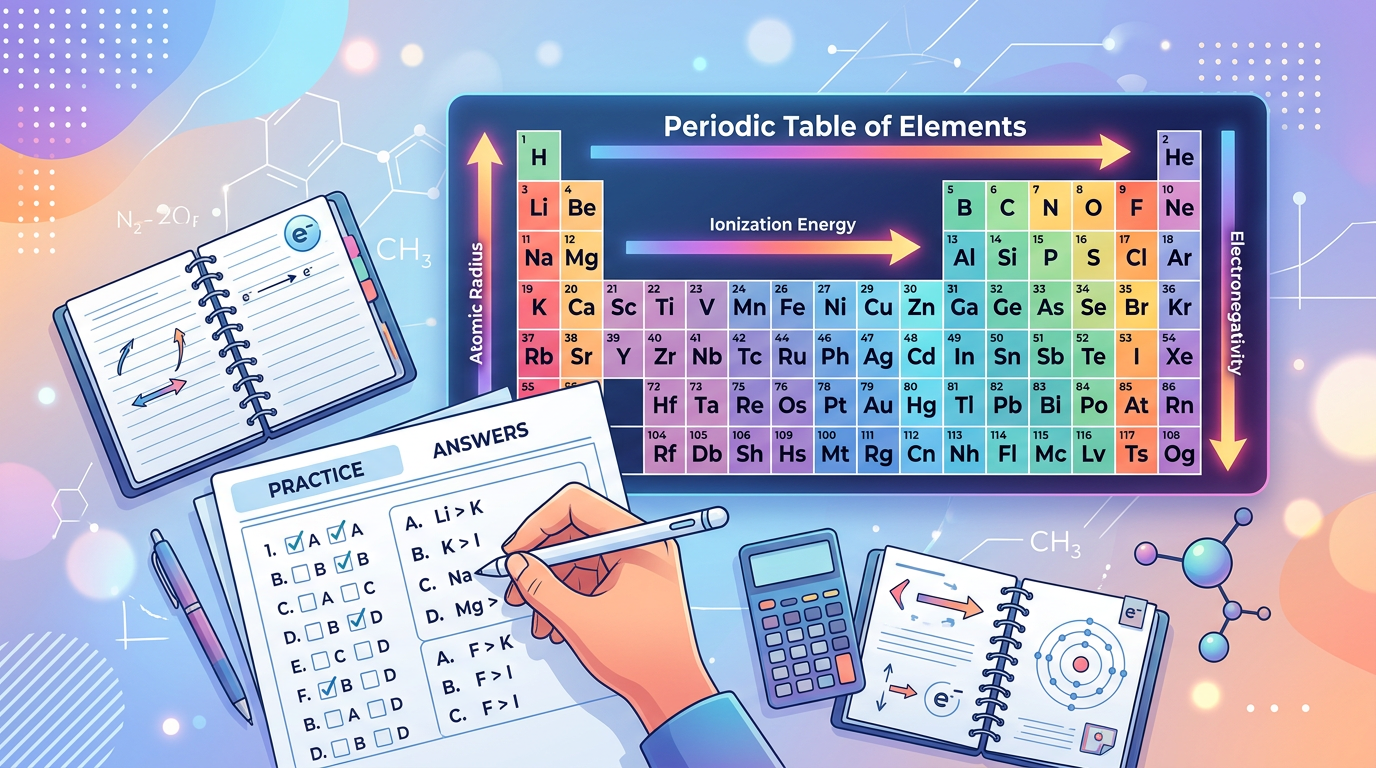
Periodic trends are the specific patterns in the properties of chemical elements that are revealed in the periodic table of elements. These trends arise from the changes in the atomic structure of elements, specifically the number of protons in the nucleus and the arrangement of electrons in their shells. Understanding these patterns allows chemists to predict how elements will behave in chemical reactions, similar to how Redox Reaction Practice Questions with Answers help students predict electron transfer in chemical equations.
The primary periodic trends include:
-
Atomic Radius: The distance from the center of the nucleus to the outermost electron shell. It increases down a group (due to additional electron shells) and decreases across a period (due to increased nuclear charge pulling electrons closer).
-
Ionization Energy: The energy required to remove an electron from a gaseous atom. It increases across a period and decreases down a group.
-
Electronegativity: A measure of an atom's ability to attract shared electrons in a chemical bond. This concept is fundamental to understanding bond polarity, as detailed on Wikipedia's Electronegativity page.
-
Electron Affinity: The energy change that occurs when an electron is added to a neutral atom to form a negative ion.
-
Metallic Character: How easily an atom can lose an electron. This increases down a group and decreases across a period.
To master periodic trends, one must understand the Effective Nuclear Charge (Zeff) and the Shielding Effect. Zeff is the net positive charge experienced by valence electrons. As you move across a period, Zeff increases because protons are added to the nucleus while the inner-shell shielding remains relatively constant. This explains why atoms get smaller and ionization energy increases as you move from left to right. For more advanced practice on how atoms interact in gas states, you might explore Ideal Gas Law (PV = nRT) Practice Questions with Answers.
Solved Examples
Review these step-by-step solutions to understand how to apply periodic trend theories to specific problems.
-
Example 1: Ranking Atomic Radius
Rank the following elements in order of increasing atomic radius: Fluorine (F), Cesium (Cs), and Calcium (Ca).-
Identify the position on the periodic table: F is in Period 2, Group 17; Ca is in Period 4, Group 2; Cs is in Period 6, Group 1.
-
Apply the group trend: Radius increases as you go down a group. Cs is much further down than Ca and F.
-
Apply the period trend: Radius decreases as you go left to right. F is to the far right, making it the smallest.
-
Final Order: F < Ca < Cs.
-
-
Example 2: Comparing Ionization Energy
Which has a higher first ionization energy: Nitrogen (N) or Oxygen (O)?-
Note the general trend: Ionization energy usually increases across a period.
-
Check for exceptions: Nitrogen has a half-filled p-subshell (2p³), which is exceptionally stable.
-
Analyze Oxygen: Oxygen (2p⁴) has one pair of electrons in a p-orbital. The electron-electron repulsion in that pair makes it slightly easier to remove an electron than from Nitrogen.
-
Conclusion: Nitrogen has a higher first ionization energy than Oxygen due to subshell stability.
-
-
Example 3: Identifying Electronegativity Trends
Between Chlorine (Cl) and Bromine (Br), which is more electronegative?-
Identify their group: Both are Halogens in Group 17.
-
Apply the vertical trend: Electronegativity decreases as you move down a group because the valence electrons are further from the nucleus and more shielded.
-
Compare: Chlorine is in Period 3, while Bromine is in Period 4.
-
Conclusion: Chlorine is more electronegative than Bromine.
-
Practice Questions
-
Which element has the largest atomic radius: Lithium (Li), Potassium (K), or Francium (Fr)?
-
Arrange the following in order of increasing electronegativity: Sulfur (S), Oxygen (O), and Selenium (Se).
-
Explain why the second ionization energy of Sodium (Na) is significantly higher than its first ionization energy.
Want unlimited practice questions like these?
Generate AI-powered questions with step-by-step solutions on any topic.
Try Question Generator Free →-
Which has a smaller ionic radius: Na⁺ or Mg²⁺? Provide a reason based on nuclear charge.
-
Rank the following by increasing first ionization energy: Carbon (C), Fluorine (F), and Beryllium (Be).
-
Which element in Period 3 has the highest electron affinity?
-
Define "isoelectronic series" and rank these ions by decreasing size: O²⁻, F⁻, Na⁺, Mg²⁺.
-
Why does atomic radius decrease from left to right across a period despite the increase in the number of electrons?
-
Compare the metallic character of Germanium (Ge) and Tin (Sn). Which is more metallic?
-
Which group in the periodic table has the lowest first ionization energies?
Answers & Explanations
-
Francium (Fr): Atomic radius increases as you move down a group because new energy levels (shells) are added, placing valence electrons farther from the nucleus.
-
Se < S < O: Electronegativity increases as you move up a group. Oxygen is at the top of Group 16, followed by Sulfur, then Selenium.
-
Core Electron Removal: Sodium's first electron is removed from the 3s orbital. The second electron must be removed from the 2p orbital, which is a stable, full noble gas core closer to the nucleus, requiring vastly more energy.
-
Mg²⁺ is smaller: Both ions are isoelectronic (10 electrons), but Magnesium has 12 protons compared to Sodium's 11. The higher nuclear charge in Mg²⁺ pulls the electrons closer to the nucleus.
-
Be < C < F: Ionization energy increases from left to right across a period as the effective nuclear charge increases, holding electrons more tightly.
-
Chlorine (Cl): In Period 3, Chlorine has the highest electron affinity because it is one electron away from a stable octet and has a relatively high Zeff.
-
O²⁻ > F⁻ > Na⁺ > Mg²⁺: These are isoelectronic (all have 10 electrons). The size decreases as the number of protons increases (O=8, F=9, Na=11, Mg=12), as more protons exert a stronger pull on the same number of electrons.
-
Increased Zeff: As you move across, protons are added to the nucleus, increasing the positive charge. Since the added electrons go into the same shell, shielding doesn't increase much, so the nucleus pulls the electron cloud tighter.
-
Tin (Sn): Metallic character increases down a group. Since Tin is below Germanium in Group 14, it loses electrons more easily and exhibits more metallic properties.
-
Group 1 (Alkali Metals): These elements have only one valence electron in a new shell, which is far from the nucleus and well-shielded, making it very easy to remove.
Quick Quiz
1. Which element has the highest electronegativity on the Pauling scale?
- A Cesium
- B Oxygen
- C Fluorine
- D Helium
Check answer
Answer: C. Fluorine
2. What happens to the atomic radius as you move from left to right across Period 2?
- A It increases
- B It decreases
- C It remains constant
- D It doubles
Check answer
Answer: B. It decreases
3. Which of the following ions is the largest?
- A P³⁻
- B S²⁻
- C Cl⁻
- D K⁺
Check answer
Answer: A. P³⁻
4. Ionization energy is best defined as the energy required to:
- A Add an electron to a solid atom
- B Remove an electron from a gaseous atom
- C Break a chemical bond
- D Move an electron to a higher energy level
Check answer
Answer: B. Remove an electron from a gaseous atom
5. Which element would have the lowest first ionization energy?
- A Neon
- B Lithium
- C Rubidium
- D Silicon
Check answer
Answer: C. Rubidium
Want unlimited practice questions like these?
Generate AI-powered questions with step-by-step solutions on any topic.
Try Question Generator Free →Frequently Asked Questions
What is the general trend for atomic radius?
Atomic radius generally increases as you move down a group due to the addition of electron shells and decreases as you move left to right across a period because of the increasing effective nuclear charge. You can find more details on this trend at Khan Academy's Chemistry section.
Why do noble gases have very high ionization energies?
Noble gases have completely filled valence shells, which represent a highly stable electronic configuration. Removing an electron from such a stable state requires a significant amount of energy to overcome the strong nuclear attraction and the loss of stability.
How does shielding affect periodic trends?
Shielding occurs when inner electrons block the attraction between the nucleus and the valence electrons. This effect remains relatively constant across a period but increases down a group, contributing to the increase in atomic size and decrease in ionization energy as you move down.
Which element has the highest electron affinity?
Chlorine typically has the highest electron affinity among all elements. While Fluorine is more electronegative, its small size leads to significant electron-electron repulsion, making it slightly less favorable to add an electron compared to Chlorine.
What is the difference between electronegativity and electron affinity?
Electronegativity is a measure of how strongly an atom attracts electrons within a chemical bond, whereas electron affinity is the actual energy change when a neutral gaseous atom gains an electron. Electronegativity is a relative scale, while electron affinity is a measurable quantity of energy. To practice related calculations, see our Balancing Redox Practice Questions with Answers.
Want unlimited practice questions like these?
Generate AI-powered questions with step-by-step solutions on any topic.
Try Question Generator Free →
Want unlimited practice questions like these?
Generate AI-powered questions with step-by-step solutions on any topic.
Try Question Generator Free →Enjoyed this article?
Share it with others who might find it helpful.
Related Articles
Newton’s Laws Practice Questions with Answers
Master Newton's Laws with our comprehensive guide. Features clear explanations, solved examples, practice questions with answers, a quick quiz, and FAQs.
Apr 7, 2026

Velocity and Acceleration Practice Questions with Answers
Master the core physics concepts of motion with our comprehensive guide to velocity and acceleration. Includes solved examples, practice questions, and detailed answers.
Apr 7, 2026
Circuit Practice Questions with Answers
Sharpen your understanding of electrical circuits with practice questions. This guide covers Ohm's Law, series circuits, and parallel circuits with detailed examples.
Apr 7, 2026