Medium pKa and pKb Practice Questions
Concept Explanation
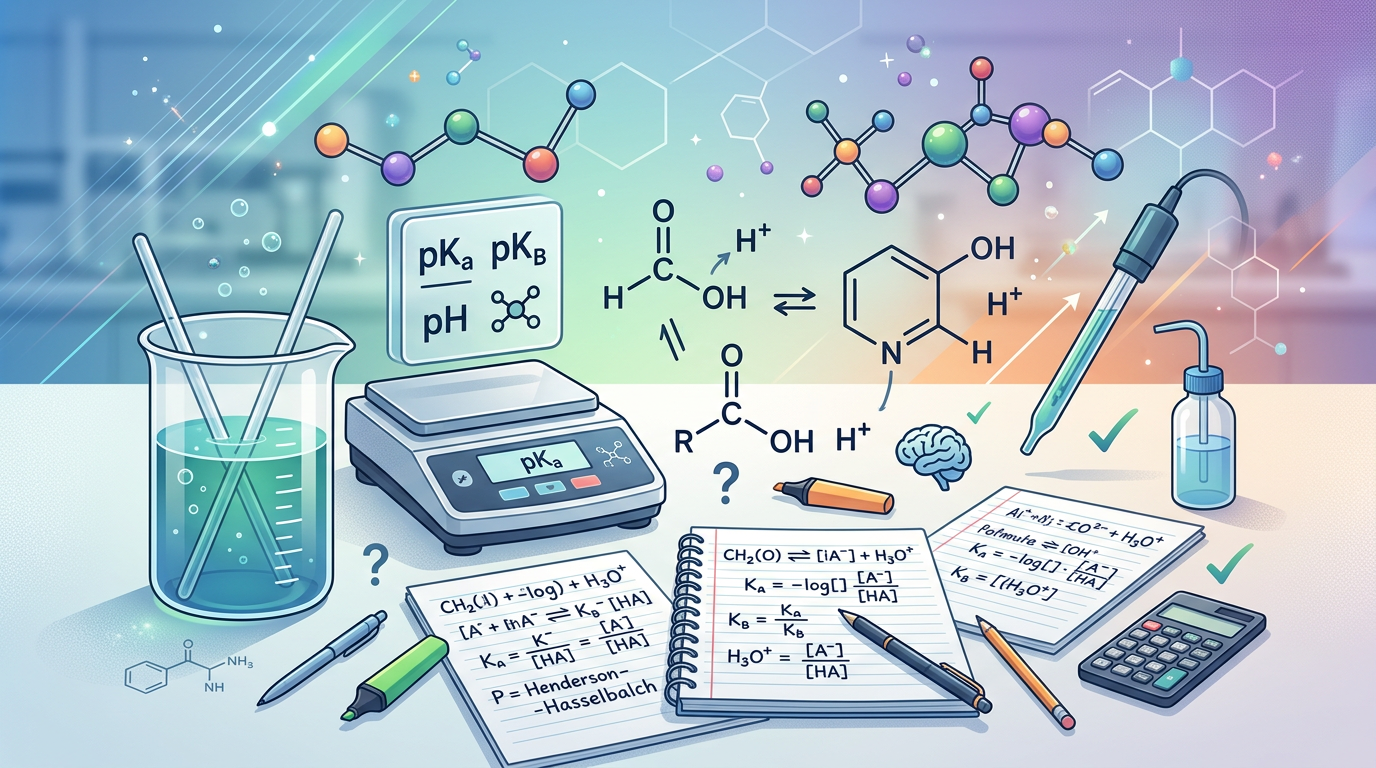
The pKa and pKb values are the negative base-10 logarithms of the acid dissociation constant (Ka) and base dissociation constant (Kb), respectively, serving as quantitative measures of the strength of acids and bases in solution. Mastering pKa and pKb practice questions is essential for understanding how molecules behave in biological systems and chemical reactions. A lower pKa indicates a stronger acid, meaning the substance more readily donates a proton, while a lower pKb indicates a stronger base. These values are intrinsically linked through the self-ionization constant of water (). At standard temperature (25°C), the relationship is defined by the equation . This relationship allows chemists to calculate the strength of a conjugate base if the strength of the parent acid is known, and vice versa. Understanding these logarithmic scales is vital for predicting the direction of equilibrium in strong acid vs weak acid comparisons and for performing complex pH calculation practice questions.
Solved Examples
Below are worked examples to demonstrate how to convert between and , and how to use the relationship between conjugate pairs.
-
Example 1: Converting Ka to pKa
An unknown weak acid has an acid dissociation constant () of . Calculate its .-
Identify the formula: .
-
Substitute the value: .
-
Calculate: .
-
-
Example 2: Finding pKb from pKa
The of hydrocyanic acid (HCN) is 9.21. Determine the of its conjugate base, the cyanide ion ().-
Identify the relationship: (at 25°C).
-
Rearrange for : .
-
Calculate: .
-
-
Example 3: Calculating Kb from pKb
A base has a of 3.30. What is the value of its base dissociation constant ()?-
Identify the formula: .
-
Substitute the value: .
-
Calculate: .
-
Practice Questions
Test your knowledge with these medium pKa and pKb practice questions. Ensure you have a scientific calculator ready for the logarithmic conversions.
1. A specific organic acid has a of . Determine its .
2. If the of ammonia () is 4.75, what is the of its conjugate acid, the ammonium ion ()?
3. Calculate the for a base that has a of 8.90.
Start Learning Smarter Today
Join thousands of students using AI-powered study tools to achieve better results.
Get Started Free
Start Learning Smarter Today
Join thousands of students using AI-powered study tools to achieve better results.
Get Started Free4. Formic acid has a of 3.75. Calculate the value and determine the of the formate ion.
5. Arrange the following acids in order of increasing strength based on their values: Acid A (), Acid B (), Acid C ().
6. A solution of methylamine has a of . Calculate both the and the of its conjugate acid.
7. Given that for nitrous acid () is , find the for the nitrite ion ().
8. Which is a stronger base: Base X with or Base Y with ?
9. A hypothetical acid has a of -2.0. Is this a strong or weak acid, and what does this imply about its ?
10. If the of a conjugate acid increases, what happens to the strength of the conjugate base?
Answers & Explanations
-
Answer: 3.35.
Explanation: Use the formula . Thus, , rounded to 3.35. -
Answer: 9.25.
Explanation: Using , we get . This is a common calculation when working with buffer solution practice questions. -
Answer: .
Explanation: . -
Answer: ; .
Explanation: . For the conjugate base, . -
Answer: Acid B < Acid A < Acid C.
Explanation: Strength increases as decreases. Acid C (1.2) is the strongest, and Acid B (4.8) is the weakest. -
Answer: ; .
Explanation: . . -
Answer: .
Explanation: . So, . -
Answer: Base X.
Explanation: Convert Base Y's to : . Since Base X has a lower (3.5), it is the stronger base. -
Answer: Strong acid; .
Explanation: A negative indicates a very strong acid that dissociates completely or nearly completely in water. . -
Answer: The conjugate base becomes stronger.
Explanation: As increases, the acid becomes weaker. Because , a higher means a lower , which signifies a stronger conjugate base.
Quick Quiz
1. Which of the following pKa values represents the strongest acid?
- A 10.5
- B 4.2
- C 1.5
- D 7.0
Check answer
Answer: C. 1.5
2. If an acid has a pKa of 5.0, what is the pKb of its conjugate base?
- A 5.0
- B 14.0
- C 9.0
- D -5.0
Check answer
Answer: C. 9.0
3. How is Ka related to pKa?
- A pKa = Ka / 14
- B pKa = -log(Ka)
- C pKa = 10^Ka
- D pKa = ln(Ka)
Check answer
Answer: B. pKa = -log(Ka)
4. A base with a Kb of 1.0 x 10^-4 has what pKb?
- A 4.0
- B 10.0
- C -4.0
- D 1.0
Check answer
Answer: A. 4.0
5. In a conjugate acid-base pair, if the acid is very strong (pKa < 0), the conjugate base is:
- A Also very strong
- B Extremely weak
- C Neutral
- D Unstable
Check answer
Answer: B. Extremely weak
Want unlimited practice questions like these?
Generate AI-powered questions with step-by-step solutions on any topic.
Try Question Generator Free →Frequently Asked Questions
What is the difference between Ka and pKa?
Ka is the acid dissociation constant that measures the equilibrium concentration of ions, while pKa is the negative logarithm of that constant. The pKa scale is more convenient for comparing acid strengths because it uses smaller, more manageable numbers rather than scientific notation.
Can a pKa value be negative?
Yes, extremely strong acids like hydrochloric acid or sulfuric acid have negative pKa values. A negative pKa indicates that the acid dissociation constant (Ka) is greater than 1, meaning the acid dissociates almost completely in aqueous solution.
How does temperature affect pKa and pKb?
Since pKa and pKb are derived from equilibrium constants, they are temperature-dependent. As temperature increases, the self-ionization of water () typically increases, which shifts the relationship to a lower sum.
Why is the sum of pKa and pKb always 14?
This relationship is derived from the water auto-ionization constant, at 25°C. Taking the negative log of both sides of the equation results in .
How do pKa values help in predicting reaction direction?
Acid-base reactions favor the side with the weaker acid and weaker base. By comparing the pKa values of the acids on both sides of the equation, you can predict that the equilibrium will shift toward the species with the higher pKa value.
Start Learning Smarter Today
Join thousands of students using AI-powered study tools to achieve better results.
Get Started FreeEnjoyed this article?
Share it with others who might find it helpful.
Related Articles
Newton’s Laws Practice Questions with Answers
Master Newton's Laws with our comprehensive guide. Features clear explanations, solved examples, practice questions with answers, a quick quiz, and FAQs.
Apr 7, 2026

Velocity and Acceleration Practice Questions with Answers
Master the core physics concepts of motion with our comprehensive guide to velocity and acceleration. Includes solved examples, practice questions, and detailed answers.
Apr 7, 2026
Circuit Practice Questions with Answers
Sharpen your understanding of electrical circuits with practice questions. This guide covers Ohm's Law, series circuits, and parallel circuits with detailed examples.
Apr 7, 2026