Medium Acid-Base Titration Practice Questions
Concept Explanation
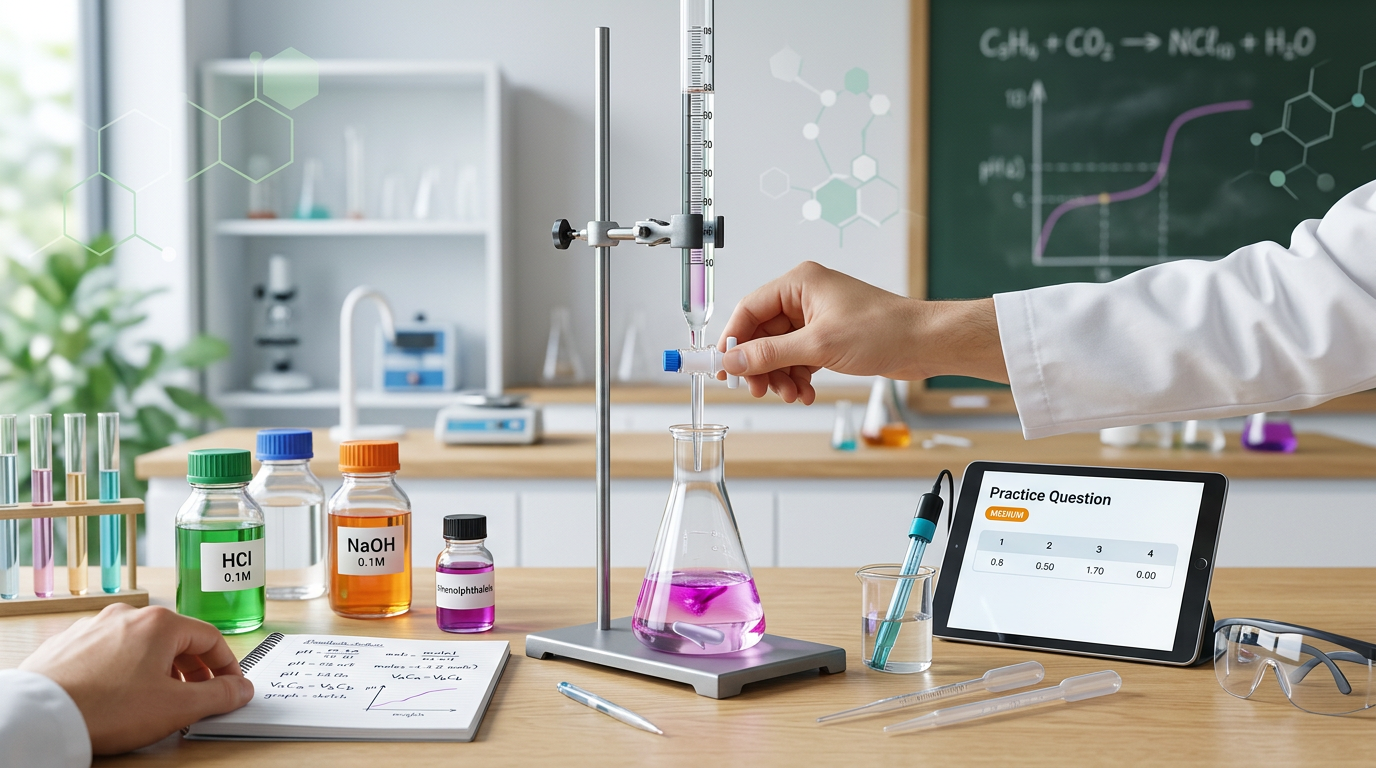
Acid-base titration is a quantitative analytical technique used to determine the unknown concentration of an acid or a base by neutralizing it with a standard solution of known concentration. This process relies on the stoichiometry of the neutralization reaction, where the moles of hydronium ions (H₃O⁺) from the acid react with an equivalent amount of hydroxide ions (OH⁻) from the base. The point at which the moles of acid and base are chemically equivalent is called the equivalence point. To detect this, chemists use indicators or pH meters to identify the endpoint, which is the physical signal that neutralization has occurred. For complex scenarios involving weak species, you may need to apply the Henderson-Hasselbalch Equation to calculate the pH during the buffering region. Understanding the difference between strong and weak electrolytes is essential, as detailed in our guide on strong acid vs weak acid practice questions. High-quality resources like Khan Academy and the LibreTexts Chemistry library provide extensive theoretical foundations for these calculations.
Solved Examples
Review these step-by-step solutions to master medium-level titration calculations involving molarity and stoichiometry.
-
Example 1: Strong Acid-Strong Base Titration
Calculate the molarity of an HCl solution if 25.00 mL of the acid required 32.45 mL of 0.150 M NaOH to reach the equivalence point.-
Write the balanced equation: HCl + NaOH → NaCl + H₂O.
-
Calculate moles of NaOH: 0.03245 L × 0.150 mol/L = 0.0048675 mol.
-
Use stoichiometry (1:1 ratio): Moles of HCl = 0.0048675 mol.
-
Calculate Molarity of HCl: 0.0048675 mol / 0.02500 L = 0.1947 M.
-
-
Example 2: Diprotic Acid Neutralization
What volume of 0.250 M KOH is needed to completely neutralize 50.0 mL of 0.100 M H₂SO₄?-
Write the balanced equation: H₂SO₄ + 2KOH → K₂SO₄ + 2H₂O.
-
Calculate moles of H₂SO₄: 0.0500 L × 0.100 mol/L = 0.00500 mol.
-
Use stoichiometry (1:2 ratio): Moles of KOH = 0.00500 mol × 2 = 0.0100 mol.
-
Calculate Volume of KOH: 0.0100 mol / 0.250 mol/L = 0.0400 L or 40.0 mL.
-
-
Example 3: Finding pH at the Half-Equivalence Point
A 50.0 mL sample of 0.10 M acetic acid (Ka = 1.8 x 10⁻⁵) is titrated with 0.10 M NaOH. What is the pH when 25.0 mL of NaOH has been added?-
Identify the stage: 25.0 mL is half of the 50.0 mL required for the equivalence point. This is the half-equivalence point.
-
Apply the principle: At the half-equivalence point, [HA] = [A⁻].
-
Calculate: pH = pKa = -log(1.8 x 10⁻⁵) = 4.74.
-
Practice Questions
-
A 20.0 mL sample of HBr is titrated with 0.250 M LiOH. If 18.4 mL of the base is required to reach the endpoint, what is the molarity of the HBr?
-
How many grams of Ca(OH)₂ (molar mass = 74.1 g/mol) are required to neutralize 150 mL of 0.50 M HNO₃?
-
Calculate the pH of a solution formed by mixing 40.0 mL of 0.10 M HCl with 10.0 mL of 0.10 M NaOH.
[CTA_BLOCK_0]
-
A 25.0 mL sample of a weak monoprotic acid requires 35.0 mL of 0.120 M KOH to reach the equivalence point. What is the concentration of the acid?
-
During the titration of 30.0 mL of 0.15 M NH₃ with 0.15 M HCl, what is the pH after 15.0 mL of HCl has been added? (Kb for NH₃ = 1.8 x 10⁻⁵).
-
What volume of 0.500 M H₃PO₄ is required to neutralize 75.0 mL of 0.800 M Ba(OH)₂? (Assume complete neutralization).
-
A 0.450 g sample of an unknown solid monoprotic acid is dissolved in water and titrated with 0.100 M NaOH. If 36.2 mL of NaOH is required, what is the molar mass of the acid?
-
Calculate the pH at the equivalence point when 25.0 mL of 0.10 M HF (Ka = 6.6 x 10⁻⁴) is titrated with 0.10 M NaOH.
-
If 50.0 mL of 0.20 M CH₃COOH is mixed with 20.0 mL of 0.20 M NaOH, what is the resulting pH? (pKa = 4.74).
-
A titration of 10.0 mL of vinegar (acetic acid) requires 45.2 mL of 0.100 M NaOH. What is the mass percent of acetic acid in vinegar? (Density = 1.01 g/mL).
Answers & Explanations
-
0.230 M HBr: Use M₁V₁ = M₂V₂. (0.250 M × 18.4 mL) / 20.0 mL = 0.230 M.
-
2.78 g Ca(OH)₂: Moles HNO₃ = 0.150 L × 0.50 M = 0.075 mol. Ratio is 1 Ca(OH)₂ : 2 HNO₃, so 0.0375 mol Ca(OH)₂ is needed. 0.0375 mol × 74.1 g/mol = 2.778 g.
-
pH = 1.22: Moles H⁺ = 0.004, Moles OH⁻ = 0.001. Excess H⁺ = 0.003 mol. Total volume = 0.050 L. [H⁺] = 0.06 M. pH = -log(0.06) = 1.22.
-
0.168 M: Moles base = 0.035 L × 0.120 M = 0.0042 mol. Moles acid = 0.0042 mol. Molarity = 0.0042 mol / 0.025 L = 0.168 M.
-
pH = 9.26: This is the half-equivalence point for the weak base. pOH = pKb = -log(1.8 x 10⁻⁵) = 4.74. pH = 14 - 4.74 = 9.26.
-
80.0 mL: Equation: 2H₃PO₄ + 3Ba(OH)₂ → Ba₃(PO₄)₂ + 6H₂O. Moles Ba(OH)₂ = 0.060 mol. Moles acid = 0.060 × (2/3) = 0.040 mol. Volume = 0.040 / 0.500 = 0.080 L.
-
124.3 g/mol: Moles NaOH = 0.00362 mol. Moles acid = 0.00362 mol. Molar mass = 0.450 g / 0.00362 mol = 124.3 g/mol.
-
pH = 7.94: At equivalence, we have F⁻ in a total volume of 50.0 mL. [F⁻] = 0.0025 mol / 0.050 L = 0.05 M. Use Kb = Kw/Ka = 1.5 x 10⁻¹¹. [OH⁻] = √(Kb × [F⁻]) = 8.66 x 10⁻⁷. pOH = 6.06, pH = 7.94.
-
pH = 4.56: Moles acid = 0.010, Moles base = 0.004. After reaction: Moles HA = 0.006, Moles A⁻ = 0.004. pH = 4.74 + log(0.004/0.006) = 4.56. Refer to pH calculation practice questions for more help.
-
2.68%: Moles acid = 0.00452 mol. Mass acid = 0.00452 × 60.05 = 0.2714 g. Mass solution = 10.0 mL × 1.01 g/mL = 10.1 g. % = (0.2714 / 10.1) × 100 = 2.68%.
Quick Quiz
1. Which point in a titration curve is characterized by the moles of titrant being exactly enough to react with all the analyte?
- A Endpoint
- B Equivalence point
- C Buffer region
- D Initial point
Check answer
Answer: B. Equivalence point
2. In the titration of a weak acid with a strong base, what is the pH at the half-equivalence point?
- A 7.0
- B 14.0
- C Equal to the pKa of the acid
- D Equal to the pKb of the conjugate base
Check answer
Answer: C. Equal to the pKa of the acid
3. What is the primary reason for using an indicator in a titration?
- A To speed up the reaction
- B To keep the pH constant
- C To signal the endpoint of the titration
- D To increase the solubility of the analyte
Check answer
Answer: C. To signal the endpoint of the titration
4. If 50 mL of 0.1 M HCl is titrated with 0.1 M NaOH, what is the pH at the equivalence point?
- A 1.0
- B 7.0
- C 8.5
- D 13.0
Check answer
Answer: B. 7.0
5. Which of the following acids would require the most base to reach the equivalence point if the volumes and molarities are the same?
- A HCl
- B HNO₃
- C H₂SO₄
- D CH₃COOH
Check answer
Answer: C. H₂SO₄
Want unlimited practice questions like these?
Generate AI-powered questions with step-by-step solutions on any topic.
Try Question Generator Free →Frequently Asked Questions
What is the difference between the equivalence point and the endpoint?
The equivalence point is the theoretical stage where the amount of titrant added is chemically equivalent to the amount of analyte. The endpoint is the experimental point where an indicator changes color, signaling that the titration should stop.
Why is the pH at the equivalence point not always 7.0?
The pH at equivalence depends on the nature of the salt formed; strong acid-strong base titrations result in a neutral salt (pH 7), while weak acid-strong base titrations produce a basic salt (pH > 7) due to the hydrolysis of the conjugate base. You can explore this further in our pKa and pKb practice questions.
How do you choose the correct indicator for a titration?
An appropriate indicator must have a color change range (pKin ± 1) that overlaps with the steep vertical section of the titration curve near the equivalence point. For example, phenolphthalein is common for weak acid-strong base titrations because it changes color in the basic range.
What is a back titration and when is it used?
A back titration involves adding an excess of a standard reagent to the analyte and then titrating the remaining excess. It is used when the analyte is volatile, insoluble, or reacts too slowly with the titrant for a direct titration.
What happens in the buffer region of a weak acid titration?
In the buffer region, the solution contains significant amounts of both the weak acid and its conjugate base, which resists changes in pH. This region is centered around the half-equivalence point where the pH equals the pKa of the acid.
Want unlimited practice questions like these?
Generate AI-powered questions with step-by-step solutions on any topic.
Try Question Generator Free →Enjoyed this article?
Share it with others who might find it helpful.
Related Articles
Newton’s Laws Practice Questions with Answers
Master Newton's Laws with our comprehensive guide. Features clear explanations, solved examples, practice questions with answers, a quick quiz, and FAQs.
Apr 7, 2026

Velocity and Acceleration Practice Questions with Answers
Master the core physics concepts of motion with our comprehensive guide to velocity and acceleration. Includes solved examples, practice questions, and detailed answers.
Apr 7, 2026
Circuit Practice Questions with Answers
Sharpen your understanding of electrical circuits with practice questions. This guide covers Ohm's Law, series circuits, and parallel circuits with detailed examples.
Apr 7, 2026