Ka and Kb Calculations Practice Questions with Answers
Concept Explanation
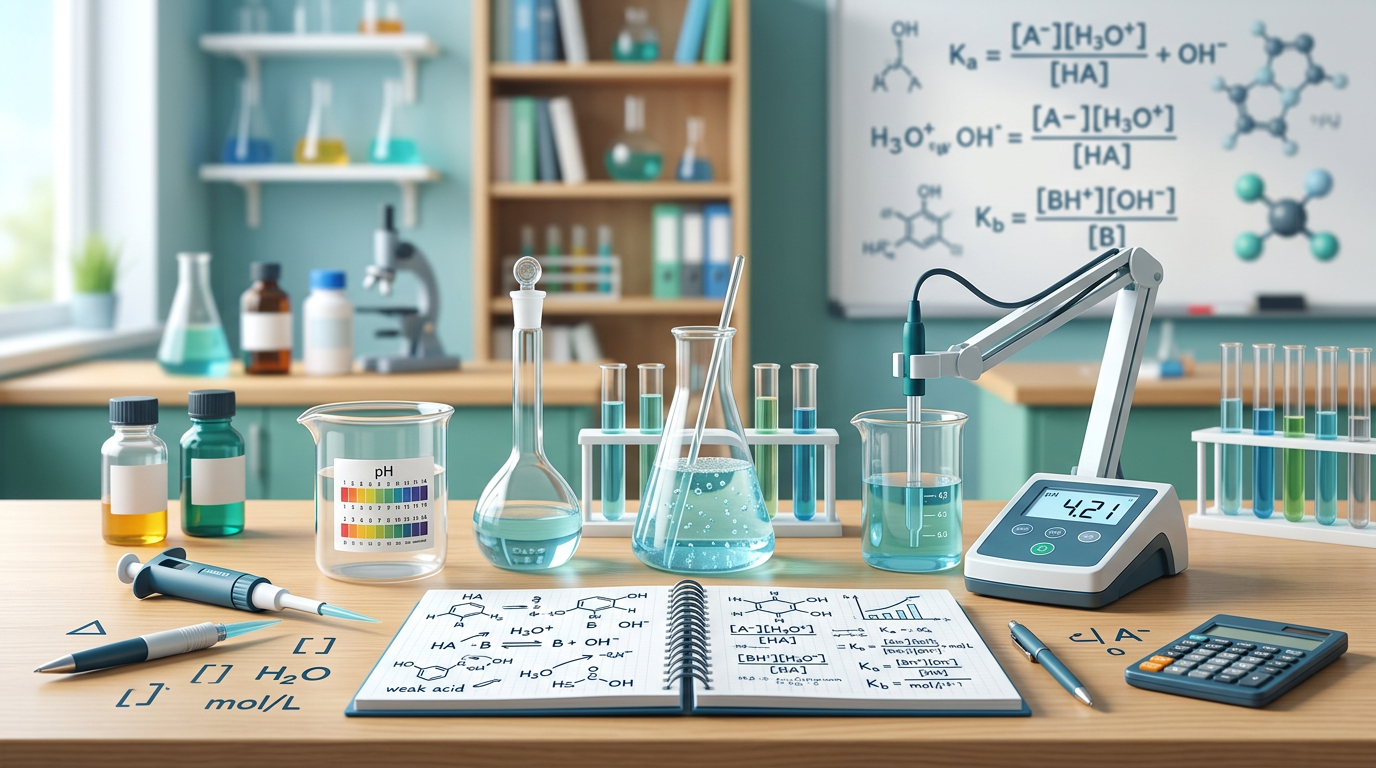
Ka and Kb calculations involve determining the acid dissociation constant (Ka) for a weak acid or the base dissociation constant (Kb) for a weak base, which quantify the extent to which these substances ionize in aqueous solutions. The acid dissociation constant, Ka, is an equilibrium constant for the dissociation of a weak acid (HA) into its conjugate base (A-) and a proton (H+), represented by the equation: HA(aq) + H2O(l) ⇌ H3O+(aq) + A-(aq). The expression for Ka is [H3O+][A-] / [HA].
Similarly, the base dissociation constant, Kb, describes the equilibrium for the dissociation of a weak base (B) in water to form its conjugate acid (BH+) and a hydroxide ion (OH-): B(aq) + H2O(l) ⇌ BH+(aq) + OH-(aq). The expression for Kb is [BH+][OH-] / [B]. These constants are crucial for understanding the strength of acids and bases, calculating pH, and predicting the behavior of solutions. A larger Ka value indicates a stronger acid, while a larger Kb value indicates a stronger base.
The relationship between Ka and Kb for a conjugate acid-base pair is given by Ka × Kb = Kw, where Kw is the ion product of water (1.0 × 10^-14 at 25°C). This relationship is fundamental for converting between acid and base strengths for conjugate pairs. Understanding molarity is essential for setting up initial concentrations in these calculations.
Solved Examples
Example 1: Calculating Ka from pH
Calculate the Ka for a 0.10 M solution of a weak acid (HA) that has a pH of 2.87.
-
Determine [H3O+] from pH: pH = -log[H3O+] [H3O+] = 10^-pH = 10^-2.87 = 1.35 × 10^-3 M
-
Set up an ICE table for the dissociation of HA: HA(aq) + H2O(l) ⇌ H3O+(aq) + A-(aq) Initial: 0.10 M 0 0 Change: -x +x +x Equilibrium: 0.10 - x x x
-
Relate [H3O+] to x: From step 1, we know [H3O+] at equilibrium is 1.35 × 10^-3 M. Therefore, x = 1.35 × 10^-3 M.
-
Calculate equilibrium concentrations: [HA] = 0.10 - x = 0.10 - 1.35 × 10^-3 = 0.09865 M [H3O+] = 1.35 × 10^-3 M [A-] = 1.35 × 10^-3 M
-
Calculate Ka: Ka = [H3O+][A-] / [HA] = (1.35 × 10^-3)(1.35 × 10^-3) / 0.09865 = 1.85 × 10^-5
Example 2: Calculating pH from Kb
What is the pH of a 0.15 M solution of ammonia (NH3), given that Kb for NH3 is 1.8 × 10^-5?
-
Set up an ICE table for the dissociation of NH3: NH3(aq) + H2O(l) ⇌ NH4+(aq) + OH-(aq) Initial: 0.15 M 0 0 Change: -x +x +x Equilibrium: 0.15 - x x x
-
Write the Kb expression and solve for x: Kb = [NH4+][OH-] / [NH3] 1.8 × 10^-5 = (x)(x) / (0.15 - x) Since Kb is small, we can approximate 0.15 - x ≈ 0.15. 1.8 × 10^-5 = x^2 / 0.15 x^2 = (1.8 × 10^-5)(0.15) = 2.7 × 10^-6 x = √(2.7 × 10^-6) = 1.64 × 10^-3 M
-
Verify approximation (if x is less than 5% of initial concentration): (1.64 × 10^-3 / 0.15) × 100% = 1.09%, which is < 5%, so the approximation is valid.
-
Calculate pOH: [OH-] = x = 1.64 × 10^-3 M pOH = -log[OH-] = -log(1.64 × 10^-3) = 2.78
-
Calculate pH: pH + pOH = 14.00 pH = 14.00 - 2.78 = 11.22
Example 3: Calculating Kb from Ka of a conjugate acid
Given that the Ka for hydrofluoric acid (HF) is 7.2 × 10^-4, calculate the Kb for its conjugate base, fluoride ion (F-).
-
Recall the relationship between Ka, Kb, and Kw: Ka × Kb = Kw Where Kw = 1.0 × 10^-14 at 25°C.
-
Solve for Kb: Kb = Kw / Ka = (1.0 × 10^-14) / (7.2 × 10^-4) = 1.39 × 10^-11
Practice Questions
1. A 0.25 M solution of a weak acid, HX, has a pH of 3.25. Calculate the Ka for this acid.
2. What is the pH of a 0.085 M solution of pyridine (C5H5N), if its Kb is 1.7 × 10^-9?
3. The Ka for acetic acid (CH3COOH) is 1.8 × 10^-5. Calculate the Kb for its conjugate base, the acetate ion (CH3COO-).
Want unlimited practice questions like these?
Generate AI-powered questions with step-by-step solutions on any topic.
Try Question Generator Free →4. A 0.050 M solution of a weak base, B, has a pOH of 4.56. Determine the Kb for this base.
5. Calculate the pH of a 0.30 M solution of hydrocyanic acid (HCN), given that its Ka is 4.9 × 10^-10.
6. If the Kb for the hypochlorite ion (ClO-) is 3.3 × 10^-7, what is the Ka for its conjugate acid, hypochlorous acid (HClO)?
7. A 0.12 M solution of a weak acid, HA, has an [H3O+] concentration of 2.1 × 10^-3 M. Calculate the Ka of HA.
8. What is the hydroxide ion concentration ([OH-]) in a 0.20 M solution of methylamine (CH3NH2), given that its Kb is 4.4 × 10^-4?
9. A weak acid solution has a Ka of 6.3 × 10^-5. If the initial concentration of the acid is 0.18 M, what is the percent ionization of the acid?
10. A 0.075 M solution of a weak base has a pH of 10.88. Calculate the Kb of the base.
Answers & Explanations
1. Ka for HX:
-
[H3O+] = 10^-pH = 10^-3.25 = 5.62 × 10^-4 M
-
ICE table for HX ⇌ H+ + X-: Initial: 0.25 M, 0, 0 Change: -x, +x, +x Equilibrium: 0.25-x, x, x
-
x = [H3O+] = 5.62 × 10^-4 M
-
[HX] = 0.25 - 5.62 × 10^-4 = 0.2494 M
-
Ka = [H+][X-] / [HX] = (5.62 × 10^-4)^2 / 0.2494 = 1.27 × 10^-6
2. pH of pyridine solution:
-
ICE table for C5H5N + H2O ⇌ C5H5NH+ + OH-: Initial: 0.085 M, 0, 0 Change: -x, +x, +x Equilibrium: 0.085-x, x, x
-
Kb = x^2 / (0.085 - x). Approximate 0.085 - x ≈ 0.085. 1.7 × 10^-9 = x^2 / 0.085 x^2 = (1.7 × 10^-9)(0.085) = 1.445 × 10^-10 x = [OH-] = √(1.445 × 10^-10) = 1.20 × 10^-5 M
-
pOH = -log(1.20 × 10^-5) = 4.92
-
pH = 14.00 - pOH = 14.00 - 4.92 = 9.08
3. Kb for acetate ion:
-
Ka × Kb = Kw = 1.0 × 10^-14
-
Kb = Kw / Ka = (1.0 × 10^-14) / (1.8 × 10^-5) = 5.6 × 10^-10
4. Kb for weak base B:
-
[OH-] = 10^-pOH = 10^-4.56 = 2.75 × 10^-5 M
-
ICE table for B + H2O ⇌ BH+ + OH-: Initial: 0.050 M, 0, 0 Change: -x, +x, +x Equilibrium: 0.050-x, x, x
-
x = [OH-] = 2.75 × 10^-5 M
-
[B] = 0.050 - 2.75 × 10^-5 = 0.04997 M
-
Kb = [BH+][OH-] / [B] = (2.75 × 10^-5)^2 / 0.04997 = 1.51 × 10^-8
5. pH of HCN solution:
-
ICE table for HCN ⇌ H+ + CN-: Initial: 0.30 M, 0, 0 Change: -x, +x, +x Equilibrium: 0.30-x, x, x
-
Ka = x^2 / (0.30 - x). Approximate 0.30 - x ≈ 0.30. 4.9 × 10^-10 = x^2 / 0.30 x^2 = (4.9 × 10^-10)(0.30) = 1.47 × 10^-10 x = [H+] = √(1.47 × 10^-10) = 1.21 × 10^-5 M
-
pH = -log(1.21 × 10^-5) = 4.92
6. Ka for hypochlorous acid (HClO):
-
Ka × Kb = Kw = 1.0 × 10^-14
-
Ka = Kw / Kb = (1.0 × 10^-14) / (3.3 × 10^-7) = 3.0 × 10^-8
7. Ka of HA:
-
Given [H3O+] = 2.1 × 10^-3 M. This is 'x' in the ICE table.
-
HA ⇌ H+ + A-: Initial: 0.12 M, 0, 0 Change: -x, +x, +x Equilibrium: 0.12-x, x, x
-
[HA] = 0.12 - 2.1 × 10^-3 = 0.1179 M
-
Ka = [H+][A-] / [HA] = (2.1 × 10^-3)^2 / 0.1179 = 3.7 × 10^-5
8. [OH-] in methylamine solution:
-
ICE table for CH3NH2 + H2O ⇌ CH3NH3+ + OH-: Initial: 0.20 M, 0, 0 Change: -x, +x, +x Equilibrium: 0.20-x, x, x
-
Kb = x^2 / (0.20 - x). Approximate 0.20 - x ≈ 0.20. 4.4 × 10^-4 = x^2 / 0.20 x^2 = (4.4 × 10^-4)(0.20) = 8.8 × 10^-5 x = [OH-] = √(8.8 × 10^-5) = 9.38 × 10^-3 M
-
Check approximation: (9.38 × 10^-3 / 0.20) × 100% = 4.69%, which is < 5%, so approximation is valid.
9. Percent ionization of weak acid:
-
ICE table for HA ⇌ H+ + A-: Initial: 0.18 M, 0, 0 Change: -x, +x, +x Equilibrium: 0.18-x, x, x
-
Ka = x^2 / (0.18 - x). Approximate 0.18 - x ≈ 0.18. 6.3 × 10^-5 = x^2 / 0.18 x^2 = (6.3 × 10^-5)(0.18) = 1.134 × 10^-5 x = [H+] = √(1.134 × 10^-5) = 3.37 × 10^-3 M
-
Percent ionization = ([H+] / [Initial HA]) × 100% = (3.37 × 10^-3 / 0.18) × 100% = 1.87%
10. Kb of the weak base:
-
pOH = 14.00 - pH = 14.00 - 10.88 = 3.12
-
[OH-] = 10^-pOH = 10^-3.12 = 7.59 × 10^-4 M. This is 'x'.
-
ICE table for B + H2O ⇌ BH+ + OH-: Initial: 0.075 M, 0, 0 Change: -x, +x, +x Equilibrium: 0.075-x, x, x
-
[B] = 0.075 - 7.59 × 10^-4 = 0.07424 M
-
Kb = [BH+][OH-] / [B] = (7.59 × 10^-4)^2 / 0.07424 = 7.76 × 10^-6
Quick Quiz
1. What does a larger Ka value indicate about a weak acid?
- A It is a weaker acid.
- B It is a stronger acid.
- C It has a higher pH.
- D It has a lower concentration.
Check answer
Answer: B. It is a stronger acid.
2. If a weak acid HA has a Ka of 2.0 x 10^-5, what is the Kb of its conjugate base A- at 25°C?
- A 5.0 x 10^-9
- B 5.0 x 10^-10
- C 2.0 x 10^9
- D 2.0 x 10^-19
Check answer
Answer: B. 5.0 x 10^-10
3. A 0.1 M solution of a weak acid has a pH of 3.0. What is the [H3O+] concentration?
- A 1.0 x 10^-1 M
- B 1.0 x 10^3 M
- C 1.0 x 10^-3 M
- D 1.0 x 10^0 M
Check answer
Answer: C. 1.0 x 10^-3 M
4. Which of the following equations correctly represents the Kb expression for a weak base B?
- A Kb = [BH+][OH-] / [B]
- B Kb = [B][OH-] / [BH+]
- C Kb = [BH+][H3O+] / [B]
- D Kb = [B][H3O+] / [BH+]
Check answer
Answer: A. Kb = [BH+][OH-] / [B]
5. If the pOH of a weak base solution is 4.0, what is the pH of the solution at 25°C?
- A 4.0
- B 7.0
- C 10.0
- D 14.0
Check answer
Answer: C. 10.0
Want unlimited practice questions like these?
Generate AI-powered questions with step-by-step solutions on any topic.
Try Question Generator Free →Frequently Asked Questions
What is the difference between Ka and Kb?
Ka (acid dissociation constant) quantifies the strength of a weak acid by measuring its tendency to donate a proton in water. Kb (base dissociation constant) quantifies the strength of a weak base by measuring its tendency to accept a proton and produce hydroxide ions in water. They are equilibrium constants for acid and base ionization, respectively.
How do you calculate Ka from pH?
To calculate Ka from pH, first determine the [H3O+] concentration using the formula [H3O+] = 10^-pH. Then, use an ICE (Initial, Change, Equilibrium) table to find the equilibrium concentrations of the acid, its conjugate base, and H3O+, and substitute these values into the Ka expression.
What is the significance of the 5% rule in Ka and Kb calculations?
The 5% rule is an approximation used when solving for 'x' in Ka or Kb equilibrium expressions. If 'x' (the change in concentration) is less than 5% of the initial concentration of the weak acid or base, then the approximation that the initial concentration minus 'x' is approximately equal to the initial concentration is considered valid, simplifying the quadratic equation.
How are Ka and Kb related for a conjugate acid-base pair?
For any conjugate acid-base pair, the product of their Ka and Kb values is equal to the ion product of water (Kw) at a given temperature, typically 1.0 × 10^-14 at 25°C. This relationship (Ka × Kb = Kw) allows you to calculate one constant if the other is known.
Why are Ka and Kb calculations important in chemistry?
Ka and Kb calculations are vital for determining the pH of weak acid and weak base solutions, understanding buffer systems, and predicting the extent of ionization. They provide quantitative measures of acid and base strength, which is fundamental to various chemical and biological processes, including acid-base properties of salts and biochemical reactions.
Can a strong acid or strong base have a Ka or Kb value?
While technically strong acids and bases do have Ka or Kb values, they are so large that they are not typically reported or used in calculations in the same way as weak acids and bases. Strong acids and bases are considered to ionize completely in water, meaning their equilibrium lies far to the right, making their Ka or Kb values effectively infinite or extremely large. Their behavior is usually described by direct stoichiometry rather than equilibrium constants, as discussed in solution preparation contexts.
Want unlimited practice questions like these?
Generate AI-powered questions with step-by-step solutions on any topic.
Try Question Generator Free →
Want unlimited practice questions like these?
Generate AI-powered questions with step-by-step solutions on any topic.
Try Question Generator Free →Enjoyed this article?
Share it with others who might find it helpful.
Related Articles
Newton’s Laws Practice Questions with Answers
Master Newton's Laws with our comprehensive guide. Features clear explanations, solved examples, practice questions with answers, a quick quiz, and FAQs.
Apr 7, 2026

Velocity and Acceleration Practice Questions with Answers
Master the core physics concepts of motion with our comprehensive guide to velocity and acceleration. Includes solved examples, practice questions, and detailed answers.
Apr 7, 2026
Circuit Practice Questions with Answers
Sharpen your understanding of electrical circuits with practice questions. This guide covers Ohm's Law, series circuits, and parallel circuits with detailed examples.
Apr 7, 2026