12 Costly ACT Reading Mistakes and How to Fix Them Fast
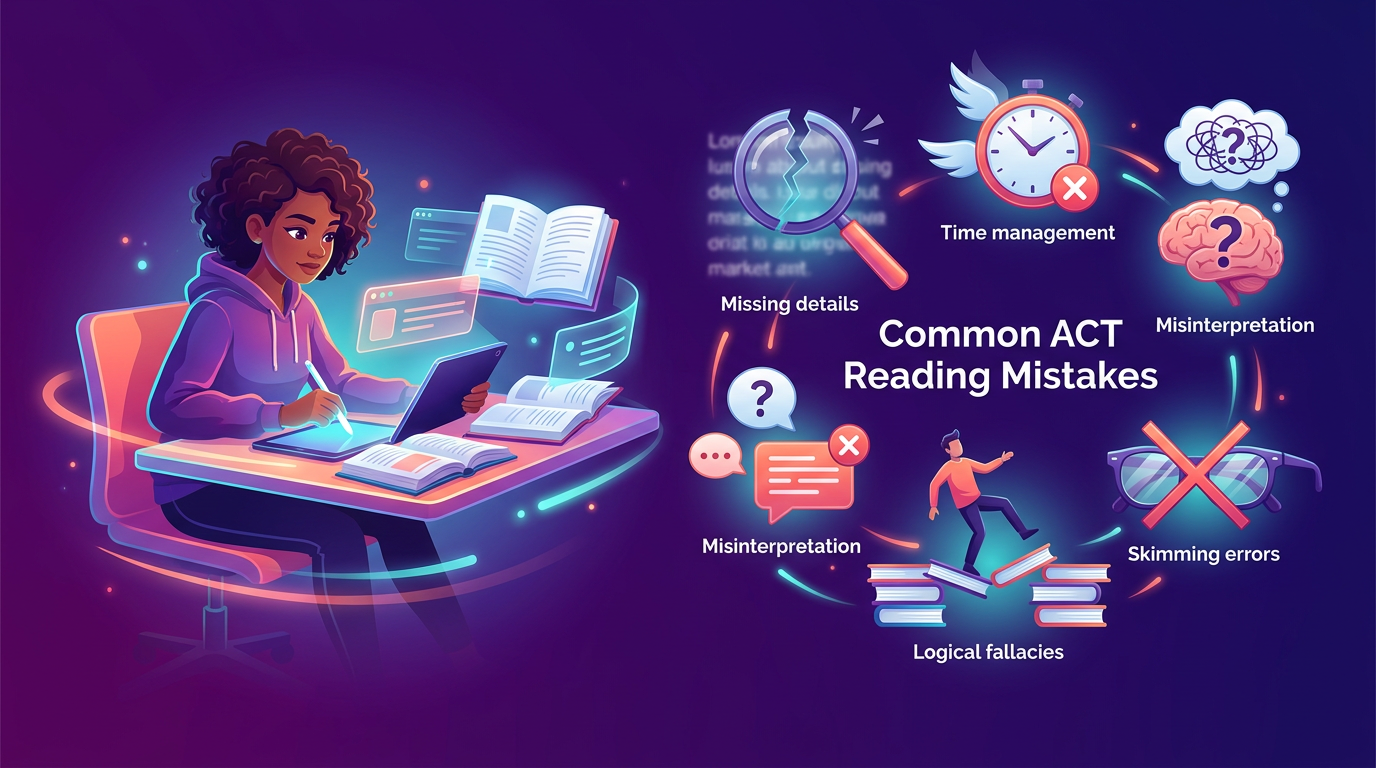
The thin margin between a 28 and a 34 on the ACT often isn't about vocabulary or intelligence; it is about avoiding the subtle traps laid by the test makers. Every year, thousands of students walk into the testing center having mastered the content but failing to grasp the mechanics of the exam itself. Avoiding Common ACT Reading Mistakes requires a shift from passive reading to active, strategic hunting. If you find yourself consistently running out of time or second-guessing between two "right" answers, you are likely falling into one of several predictable pitfalls.
Mastering this section is a core component of ACT Prep, as it tests your ability to synthesize information under extreme pressure. Unlike your high school English class, the ACT doesn't care about your creative interpretation of a text. It cares about evidence. By identifying where your process breaks down, you can implement specific ACT test prep strategies that turn your weaknesses into points on the board.
The High-Stakes Nature of ACT Reading Timing
You have exactly 35 minutes to read four passages and answer 40 questions, which mathematically allows for only 52 seconds per question—excluding the time spent reading. This brutal pace makes time management the most frequent hurdle for students. Most examinees fail because they treat the ACT like a leisure novel rather than a data-retrieval mission. If you spend five minutes reading the text and six minutes answering questions, you will never finish the final passage.
Perfectionism is a score-killer on this exam. Students often get "stuck" on a single difficult question, burning two or three minutes in a desperate attempt to find the answer. This creates a domino effect: you lose the time needed to answer three easy questions later in the test. High scorers understand that a "tough" question is worth the same as an "easy" one; they guess, mark it, and move on. To see how this applies to other sections, check out these common ACT Math mistakes to ensure your pacing is consistent across the board.
A realistic pacing strategy involves "triage." You should aim to spend no more than 8-9 minutes per passage total. This means you must develop a skimming technique that allows you to grasp the main idea and the "map" of the text in under three minutes. Instead of aiming for 100% comprehension on the first pass, aim for 60% comprehension and 100% awareness of where the details are located. If you need to scale your skills up, try working through medium ACT mixed reading practice questions to find your rhythm.
Master the Clock with AI Support
Eliminate timing anxiety by practicing with a simulator that mirrors the real ACT pressure while providing instant feedback on your pacing.
Get Started FreeFailure to Understand the Question Types
The ACT Reading section categorizes questions into distinct buckets, and failing to recognize which "bucket" a question belongs to leads to wasted energy. Explicit questions ask for information directly stated in the text, whereas implicit questions require you to identify what the author suggests. One of the most Common ACT Reading Mistakes is over-analyzing an explicit question—looking for a "deep meaning" when the answer is literally written on line 42.
Big Picture questions focus on the "why" and "what" of the entire passage, such as the author's purpose or the primary tone. Detail questions, conversely, are "search and find" missions. Students often lose points by answering a "Big Picture" question based on a specific detail from only the first paragraph. This lack of perspective shift causes high-achieving students to stumble on hard ACT reading comprehension practice questions because they miss the forest for the trees.
Inference questions are perhaps the most misunderstood. On the ACT, an "inference" is not a wild guess; it is a logical conclusion based strictly on provided facts. If the passage says, "The explorer never returned from the Arctic," you can infer the explorer's mission was unsuccessful, but you cannot infer that the explorer froze to death. The evidence must support every word of the answer choice. You can sharpen this skill by reviewing hard ACT reading passage practice questions to see how tiny nuances change the validity of an inference.
Common Errors in Passage Strategy
Treating every passage type the same is a tactical error that ignores the unique structure of ACT reading passage types. The ACT consistently provides four categories: Prose Fiction/Literary Narrative, Social Science, Humanities, and Natural Science. A Prose Fiction passage requires you to track character emotion and plot arc, while a Natural Science passage demands you track cause-and-effect and technical data. Using the same "read-everything" approach for both will leave you exhausted.
One of the most overlooked Common ACT Reading Mistakes is ignoring the introductory "blurb." This small italicized text at the start of the passage often provides the author’s name, the date of publication, and the context. Knowing that a passage was written in 1850 versus 2020 instantly tells you what kind of language and social perspectives to expect. Neglecting this context is like trying to put together a puzzle without looking at the box. For more targeted practice, students often benefit from hard ACT natural science reading practice questions to get used to the denser, data-heavy format of that specific section.
Furthermore, many students do the passages in the order they are presented (1, 2, 3, 4). This is a mistake if Humanities is your weakest subject. You should always play to your strengths. If you love science and hate fiction, start with the Science passage to build momentum and ensure you get those points before you are fatigued. Use the Bevinzey AI Exam Simulator to experiment with different passage orders and see which configuration yields the highest score for your specific skill set.
The Psychology of the 'Wrong' Answer Choice
ACT distractors are engineered to look "right" to a student who is rushing. The most common trap is the "Rotated Fact," where the answer choice uses words directly from the text but flips the relationship between them. For example, if the text says "The cat chased the dog," the trap answer might say "The dog chased the cat." Your brain recognizes the keywords—cat, dog, chased—and marks it correct without verifying the logic.
Another classic trap is the use of Extreme Language. The ACT is a moderate test. Words like "always," "never," "perfect," or "impossible" are rarely part of a correct answer unless the passage specifically uses that exact word. Correct answers often use "hedging" language like "tends to," "sometimes," or "suggests." Using the AI Lecture Notes Enhancer can help you summarize these patterns from your practice sessions into digestible study guides.
The "Half-Right" answer is perhaps the most insidious. It’s an answer choice where the first half is perfectly accurate, but the second half adds a detail that isn't in the text. Students often read the first part, feel a sense of relief that they found the answer, and stop reading. You must read every single word of an answer choice before committing. If you struggle with this, practicing hard ACT humanities reading practice questions can help, as these passages often use subtle, nuanced language designed to lead you astray.
Mistakes in Evidence-Based Thinking
One of the most dangerous things you can bring into the ACT is "Common Sense." This sounds counterintuitive, but the ACT tests your ability to read the provided text, not your knowledge of the world. If a passage claims the moon is made of green cheese, and a question asks what the moon is made of, the correct answer is "green cheese." Bringing in outside knowledge about lunar geology will lead you straight to a trap.
This "outside knowledge" bias often creeps into Social Science and Natural Science passages. If you are a biology whiz, you might answer a question based on what you learned in AP Bio rather than what the specific scientist in the passage stated. To combat this, treat every passage as if it were written about a fictional universe where only the rules on the page apply. You can also look at ACT English mistakes to see how similar rigid rules apply to grammar versus your own "intuitive" sense of how a sentence should sound.
Another error involves "Narrow Reading." When a question provides a line reference (e.g., "In line 34, the word 'bright' most nearly means..."), students often read ONLY line 34. The answer is almost always found in the two lines above and the two lines below the reference. Without that context, you are guessing at a definition. For more practice with data-heavy evidence, try hard ACT data interpretation practice questions to see how context changes the meaning of figures and facts.
Inconsistent Practice Habits and Mental Fatigue
Practicing without a timer is one of the most widespread Common ACT Reading Mistakes. If you give yourself 15 minutes to finish a passage at home, you aren't actually practicing for the ACT; you're practicing for a version of the test that doesn't exist. You must build the "mental callus" required to maintain focus for the full 35 minutes. Many students see their scores dip on the 4th passage simply because their brains are tired. Using National Center for Education Statistics data as a benchmark, we see that students who engage in timed, repetitive testing environments consistently outperform those who study in unstructured blocks.
A fatal mistake in the review process is ignoring "lucky" guesses. If you got a question right but weren't 100% sure why, you actually failed that question during practice. You must analyze every guess as if it were a mistake. Ask yourself: Why was I stuck between B and C? What word in C made it wrong? This granular analysis is what separates the elite scorers from the average ones. You can use the Metacognitive Calibration tool to track your confidence levels during practice to identify these "lucky" but dangerous gaps in your logic.
Finally, the "Check Every Answer" syndrome can kill your momentum. This occurs when a student finds the correct answer (say, B) but feels the need to read C and D just to be sure. On the ACT Reading section, there is no time for "just to be sure." If you find a choice that is 100% supported by the text, bubble it and move on. To build this confidence, refine your skills with hard ACT social science reading practice questions where the answers are often buried in dense academic prose.
Final Checklist: How to Course-Correct for a Top Score
To move toward a 36, you need a system that minimizes human error. First, maintain an Error Log. For every mistake, write down the question type, what trap you fell for, and what specific wording in the correct answer made it right. Over time, you will see patterns (e.g., "I always fall for extreme language in Science passages").
Second, develop a Personal Passage Order based on your performance data. If you consistently score 10/10 on Natural Science but 5/10 on Prose Fiction, do Science first. This ensures that if you do run out of time, you are guessing on the questions you were likely to miss anyway, rather than leaving "easy" points on the table. You might also want to practice hard ACT graph analysis practice questions to ensure the visual data portions don't slow you down.
Lastly, implement the Three-Pass Method for questions:
- Pass 1: Answer all easy, direct-reference questions first.
- Pass 2: Tackle the tougher inference and "Big Picture" questions.
- Pass 3: If there are 30 seconds left, bubble in a "Letter of the Day" for anything remaining.
Achieve Your Target ACT Score
Stop guessing and start strategizing. Use Bevinzey's AI-driven tools to pinpoint your Reading weaknesses and build a personalized MasterPlan for success.
Get Started FreeFrequently Asked Questions
How can I improve my ACT Reading timing?
Improve timing by shifting from reading for pleasure to scanning for information. Spend no more than 3 minutes reading the passage and use the remaining 5-6 minutes to "hunt" for answers using keywords from the questions.
Is it better to read the questions first or the passage first?
Most high-scorers recommend a "quick skim" of the passage first (2-3 minutes) to understand the structure, followed by the questions. Reading questions first can lead to "tunnel vision," causing you to miss the context needed for "Big Picture" questions.
Are all ACT Reading sections the same difficulty?
The difficulty is standardized, but individual perception varies. Most students find the Prose Fiction and Natural Science sections the most polarizing due to the difference between narrative and technical writing styles.
How is the ACT Reading section different from the SAT?
The ACT Reading section is much faster-paced than the SAT but generally has more straightforward, "search and find" questions. The SAT allows more time per question but requires deeper analysis and evidence-pairing across multiple questions.
What is the most common mistake students make on ACT Reading?
The most common mistake is over-reading. Students try to memorize every detail of the passage on the first pass, which wastes valuable time and is unnecessary since the passage remains available to look at while answering questions.
Can I skip the 'Double Passage' or save it for last?
Yes. If the "Paired Passages" (Comparison) format slows you down, save it for last. It requires you to synthesize two different viewpoints, which can be more mentally taxing than analyzing a single cohesive text.
Tags
Enjoyed this article?
Share it with others who might find it helpful.
Related Articles

Best GRE Practice Questions Online: 2026 Top Resources & Tips
Master the GRE with our curated list of 2026's best online practice questions and expert strategies. Boost your score with high-quality study resources.
Jun 27, 2026

Top USMLE Question Bank Alternatives: Beyond UWorld
Searching for a USMLE question bank alternative? Compare the best Step 1 and Step 2 resources like AMBOSS, Kaplan, and BoardVitals to ace your medical boards.
Jun 21, 2026

Best USMLE Question Generator Tools for Board Mastery
Master the boards with our guide to the best USMLE Question Generator tools. Learn how AI is revolutionizing Step preparation and how to create custom practice.
Jun 21, 2026