AI-Powered USMLE Practice Questions: Level Up Your Score
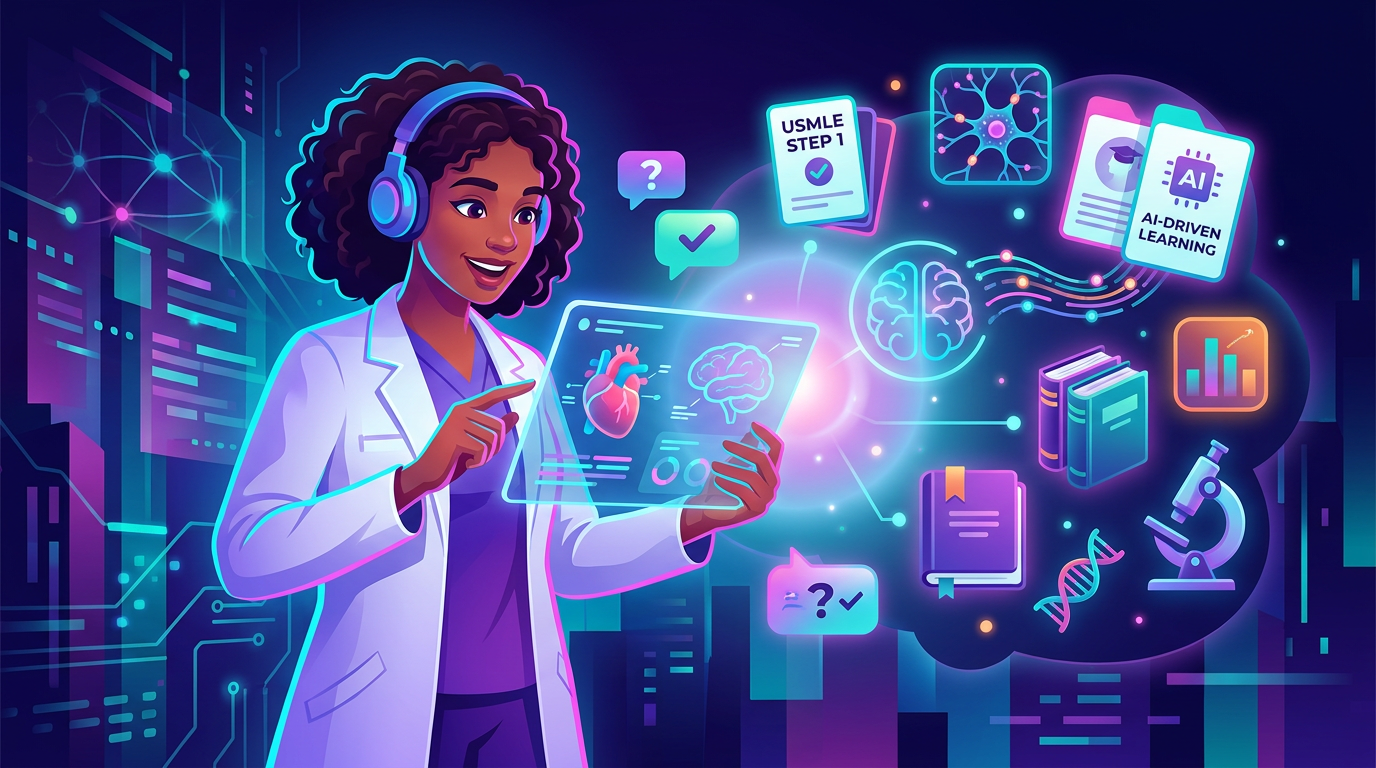
Medical education is currently witnessing a seismic shift. For decades, medical students relied on massive textbooks and static PDFs, but today, AI-Powered USMLE Practice Questions are redefining how future physicians prepare for their boards. These tools don't just present a question; they analyze how you think, identify where you stumble, and curate a curriculum designed specifically for your brain. This technology is no longer a futuristic concept—it is the baseline for high-scoring students.
The Evolution of USMLE Prep: From Paper Exams to AI Algorithms
Modern USMLE preparation has transitioned from the rote memorization of textbooks to highly sophisticated "active learning" ecosystems. In the 1990s, students carried "First Aid" like a bible, highlighting passages until the pages turned translucent. Today, the focus has shifted toward building neural pathways through retrieval practice and spaced repetition. If you are still using a one-size-fits-all study plan, you are effectively bringing a knife to a gunfight.
Traditional, static question banks serve the same 2,000 questions to every student in the same order. This ignores the fact that a student with a Master’s in Physiology needs a different focus than a student who excelled in Pathology but struggled with Pharmacology. Static banks create an illusion of competence—you might get 80% correct, but you could be wasting 50% of your time on concepts you already mastered. This inefficiency is exactly why Step 1 preparation AI has gained such massive traction in the medical community.
Artificial Intelligence represents the natural next step in this evolution because it scales according to the user. Rather than a linear path, your study journey becomes a web that expands or narrows based on your performance. You can find more details on this transition in our resource on how to use practice questions for USMLE success. The goal is no longer just "finishing the bank"—it is achieving mastery with surgical precision.
How AI-Powered USMLE Practice Questions Work
AI-Powered USMLE Practice Questions function by using machine learning models to dynamically adjust the difficulty and subject matter of your practice sessions. These systems rely on Item Response Theory (IRT), a psychometric model that calculates the probability of a specific student answering a specific question correctly. If you get a question right, the AI doesn't just give you a green checkmark; it updates your latent ability score and serves a harder question next.
Natural Language Processing (NLP) plays a critical role in generating these scenarios. High-level LLMs can analyze thousands of medical cases from sources like the Centers for Disease Control and Prevention (CDC) and the New England Journal of Medicine to create realistic patient vignettes. This ensures that the flavor of the questions mimics the NBME style—distractors that are plausible, "next best step" scenarios, and multi-step reasoning puzzles.
Furthermore, machine learning algorithms excel at pattern recognition. They don't just see that you missed a question on the Heart Failure; they see that you consistently miss questions where Heart Failure is combined with Chronic Obstructive Pulmonary Disease (COPD). By identifying these complex correlations, the AI can force you to confront your specific weak points. For those focusing on specific systems, exploring hard USMLE cardiovascular pathology practice questions is a great way to test these systems in action.
Key Benefits of Using AI for Step 1 and Step 2 CK Prep
The primary benefit of AI-powered systems is hyper-personalization, allowing students to shave hundreds of hours off their total study time. According to the National Center for Education Statistics, personalized learning environments consistently lead to better retention and higher test scores across all STEM fields. In the context of USMLE Step 2 CK AI questions, this means the system understands your "forgetting curve" and reintroduces high-yield facts just before they slip from your memory.
Personalization goes beyond just topic selection. Many modern platforms utilize confidence tracking, asking you to rate how sure you are of an answer before you submit it. This helps eliminate the "guessing factor." If you get a question right but marked it as a "guess," the AI treats it as a knowledge gap. This prevents you from ignoring a topic simply because you got lucky with a 25% chance of guessing correctly.
Efficiency is the lifeblood of a third-year medical student on rotations. When you only have 30 minutes between rounds, you cannot afford to browse through 40 random questions. Adaptive learning medical boards AI ensures that every single question you see is the most valuable question you could be answering at that exact moment. By automating the schedule, tools like the AI MasterPlan allow you to focus entirely on learning rather than managing a spreadsheet.
Comparing AI Q-Banks vs. Traditional Leaders
Traditional leaders like UWorld and Amboss are the gold standards because of their meticulously vetted, human-written content. However, AI-Powered USMLE Practice Questions are not necessarily trying to replace these providers, but rather evolve them. While UWorld offers incredible explanations, an AI-integrated platform offers interactivity. You can't ask a static PDF to "explain this to me like I'm a five-year-old" or "compare this condition to the one I missed yesterday," but you can with an AI tutor.
Clinical accuracy is the main hurdle for AI. To compete with the rigor of the USMLE Prep hub, AI platforms must use a "Human-in-the-Loop" (HITL) system. This means that while the AI generates the structure and logic of a question, medical doctors review the content to ensure it aligns with the latest clinical guidelines from the Mayo Clinic. The result is a hybrid that combines human expertise with machine efficiency.
In terms of cost-benefit, AI platforms often provide a higher ROI because they include multiple tools in one subscription. For example, instead of paying for a separate Q-bank, flashcard app, and mock exam service, a student can use a tool like the AI Question Generator to create custom sets on the fly. This integration streamlines the study process and keeps all performance data in one central repository.
Predictive Analytics: Knowing Your Score Before Exam Day
AI can now predict your USMLE score with startling accuracy by using deep learning models that compare your data to thousands of previous test-takers. Instead of the vague "percent correct" metric, predictive analytics USMLE systems provide a probability curve. They might tell you that you have a 92% chance of scoring between 245 and 255. This certainty is a massive psychological advantage, drastically reducing exam-day anxiety and burnout.
These models don't just look at whether you got the answer right. They analyze your "time-to-answer," whether you changed your answer from right to wrong, and how you perform during different times of the day. This level of granular data helps you identify if your "drop" in performance is due to a lack of knowledge or simply decision fatigue. Using an AI Exam Simulator can provide the necessary "stress-test" data needed to refine these predictions before you sit for the real thing.
Master the Boards with Precision AI
Stop guessing and start knowing. Our AI-driven platform adapts to your strengths and weaknesses to ensure you're exam-ready on day one.
Get Started FreeThe Role of GenAI and LLMs in Creating High-Yield Content
Generative AI and Large Language Models (LLMs) have revolutionized content creation, but they require strict guardrails in medicine. When a student uses an AI tutor medical students trust, they are interacting with an LLM that has been fine-tuned on high-yield medical literature. This prevents "hallucinations"—the AI making up facts—by forcing the model to cite its sources from credible medical databases.
The real power of LLMs lies in building clinical reasoning. Instead of just memorizing that Streptococcus pneumoniae is the most common cause of community-acquired pneumonia, you can engage in a dialogue. You can ask the AI to differentiate its presentation from Mycoplasma pneumoniae in a young adult. This conversational approach mimics the "pimping" sessions students face on clinical rotations, preparing them for the oral components of their future careers.
For those looking to dive into specific high-yield topics, practicing with hard USMLE pathology practice questions is a perfect way to see how AI handles nuanced clinical distinctions. The AI can adapt these questions to highlight the subtle differences in histology or pathophysiology that often separate a 230 score from a 260.
Choosing the Right AI USMLE Tool: A Buyer’s Guide
When selecting a platform, the first thing to look for is the quality of the underlying data. An AI-Powered USMLE Practice Questions bank is only as good as the medical literature it was trained on. Ensure the platform explicitly mentions "Human-in-the-Loop" oversight. If the explanations sound robotic or contain anatomical errors, the AI hasn't been properly constrained by medical experts.
Essential features for the modern student include:
- Cross-platform synchronization (study on your phone during transit).
- Integrated spaced repetition systems (like Anki, but automated).
- Comprehensive performance dashboards that track progress by organ system and discipline.
- The ability to generate notes from questions, such as using an AI Lecture Notes Enhancer.
Finally, consider the versatility of the tool. Does it offer a Retrieval Challenge to keep your memory sharp? Does it have a robust bank of unlimited USMLE practice questions? The best tools don't just give you a Q-bank; they provide an entire ecosystem that supports every phase of your study cycle, from initial learning to final review.
The Future of Medical Licensing: Beyond Multiple Choice
Will AI eventually replace the standardized exam? While the NBME is unlikely to scrap the Step exams anytime soon, the format is poised for a major change. We are likely moving toward "continuous assessment" models. Instead of one high-stakes day that determines your residency prospects, AI could track your clinical competency over four years of medical school.
This transition toward competency-based assessment is already being discussed at the highest levels of medical education. AI can simulate "Virtual Patients" where the student must interact in real-time, order labs, and manage complications. This goes far beyond picking A, B, or C. It tests the actual art of medicine. Until that day comes, mastery of machine learning medical exams platforms remains the best way to ensure you are ready for whatever the boards throw at you.
Ready to Level Up Your USMLE Score?
Join thousands of medical students using Bevinzey to simplify their study process and crush their Step exams with AI-powered tools.
Get Started FreeFrequently Asked Questions
Are AI-powered USMLE questions as accurate as UWorld or Amboss?
When combined with human-in-the-loop oversight, AI-powered questions reach the same level of clinical accuracy as traditional leaders while providing superior personalization.
Can AI predict my actual USMLE Step 1 or Step 2 CK score?
Yes, by analyzing thousands of data points including time-to-answer and performance trends, AI models can predict your score with a high degree of statistical confidence.
Is it considered cheating to use AI for medical board preparation?
No, using AI tools like adaptive Q-banks or flashcard generators is a recognized and encouraged form of advanced study technology designed to enhance learning efficacy.
How does AI create personalized study schedules for medical students?
AI observes your performance in real-time and uses algorithms like the SM-2 for spaced repetition to prioritize topics where you have the largest knowledge gaps.
What are the best AI tools currently available for USMLE prep?
Top tools include integrated platforms that offer adaptive Q-banks, AI-driven flashcards, and predictive score analytics to provide a holistic study experience.
Tags
Enjoyed this article?
Share it with others who might find it helpful.
Related Articles

Best GRE Practice Questions Online: 2026 Top Resources & Tips
Master the GRE with our curated list of 2026's best online practice questions and expert strategies. Boost your score with high-quality study resources.
Jun 27, 2026
Top USMLE Question Bank Alternatives: Beyond UWorld
Searching for a USMLE question bank alternative? Compare the best Step 1 and Step 2 resources like AMBOSS, Kaplan, and BoardVitals to ace your medical boards.
Jun 21, 2026
Best USMLE Question Generator Tools for Board Mastery
Master the boards with our guide to the best USMLE Question Generator tools. Learn how AI is revolutionizing Step preparation and how to create custom practice.
Jun 21, 2026